Problems and issues occur often in any workplace. They are a normal part of working with people, making decisions, and improving outcomes. What matters is not whether problems arise, but how we respond to them.
Too often, conversations move quickly to solutions without first achieving clarity. Assumptions are made, perspectives are missed, and actions are taken without a shared understanding of the problem.
If we want better outcomes, we must become more deliberate in how we listen, how we question, and how we move to action. This requires a shift from passive engagement to disciplined thinking. It requires us to slow down, build clarity, and create agreement before acting. This approach is not about talking more. It is about thinking better together.
1. Getting to Agreement

There is a fundamental difference between listening and active listening, and that difference determines whether a conversation leads to clarity or confusion.
Listening, in its simplest form, is passive. It is sitting, hearing words, and waiting for your turn to respond. It often creates the illusion of understanding, but rarely leads to meaningful progress.
Active listening is intentional and disciplined. It is driven by a clear focus on understanding, not reacting. The goal is not to respond quickly or appear engaged, but to achieve genuine clarity. It requires patience, purposeful questioning, and a willingness to slow the conversation down so the thinking becomes visible. When done well, it moves a discussion from surface-level talk to deep understanding, where both people can clearly see the issue and work toward a meaningful solution.
When we are actively listening, we are deliberately reserving judgement. We are not forming opinions, preparing rebuttals, or deciding whether we agree or disagree. Our role in that moment is to understand exactly what is being said, as it is intended. This creates space for the other person to think more clearly and ensures that what is eventually acted on is based on accurate understanding, not assumption.
2. Understanding the Problem

Before clarity can be achieved, the problem must be surfaced and understood. This requires space for the other person to explain, unpack, and explore what is happening. At this stage, the role of the listener is not to solve, but to understand. Strong questions and patient listening help bring the issue into the open, making the invisible visible.
3. Building Clarity Through Questions
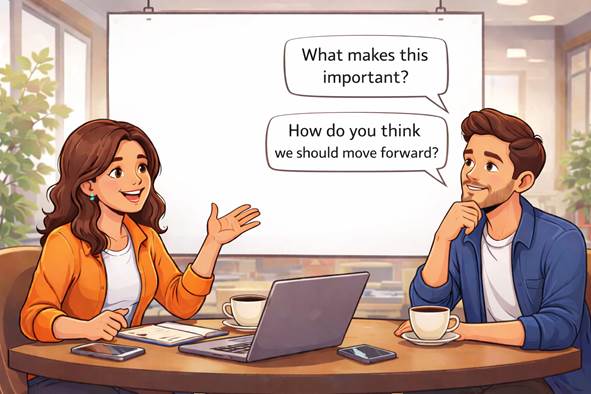
The most effective way to do this is through carefully constructed questions, particularly those that begin with what and how.
These questions force both parties to move beyond surface-level descriptions and into specifics. They require detail, examples, and precision. The goal is clarity. Clarity means you can see the issue. Not vaguely, not partially, but as a clear picture in your mind. You understand what is happening, why it is happening, and what sits beneath it.
If you cannot clearly describe the issue, you do not yet understand it well enough to solve it and if you cannot see it, you cannot solve it. Once clarity is established, the next step is agreement. Both parties must be aligned on what success looks like. This requires a deliberate shift in questioning toward the future. The key question becomes: What do we want to see?
The word we matters. It signals shared ownership and a collective commitment to the outcome. Without agreement on the desired outcome, action becomes fragmented and inconsistent. With agreement, there is direction, purpose, and a clear standard against which progress can be measured.
4. From Clarity to Action: Generating Options

Once clarity has been achieved, the conversation must deliberately shift into option generation.
At this stage, the goal is not to find the answer quickly, but to expand thinking. A minimum of five options should be generated. Nine is better.
This prevents early closure, where the first reasonable idea is accepted without challenge. It pushes both parties beyond the obvious and encourages deeper, more considered thinking. Often, the best solution sits beyond the first few responses.
The key question remains: What do we want to see? The word we matters. It creates shared ownership, reinforces collective responsibility, and ensures that the options generated are aligned to a common goal rather than individual preference.
Strong option generation creates choice. And with choice comes the ability to select the most effective path forward, not just the most immediate one.
5. Turning Agreement into Process
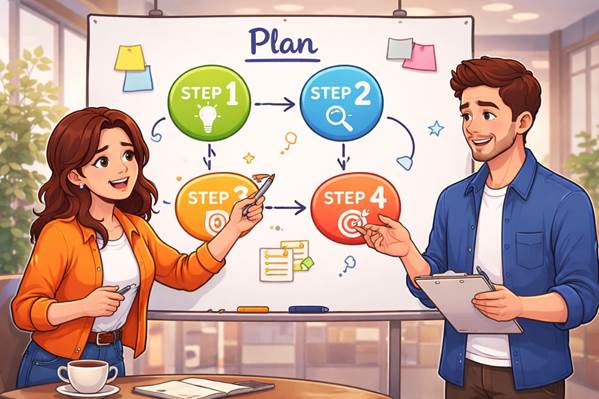
Once a range of options has been developed, the focus turns to agreement.
This is a deliberate step. It requires both parties to step back, review the options, and assess them against the agreed outcome. The question is no longer what could we do, but what should we do. Together, both parties identify the option most likely to lead to meaningful and sustainable improvement.
Agreement matters. Without it, action becomes inconsistent. One person may move forward with confidence, while the other remains uncertain or unconvinced. True agreement creates alignment, clarity of direction, and a shared commitment to the next steps. After agreement comes process.
The agreed solution must be broken down into clear, actionable steps. Each step should be specific, visible, and achievable. Responsibility should be explicit so there is no ambiguity about who is doing what. Timeframes should be considered to maintain momentum.
Equally important are agreed check-ins. These create accountability and provide opportunities to review progress, address challenges, and make adjustments if needed. Without follow-through, even the strongest agreement loses impact.
Clarity leads to agreement. Agreement leads to action. Process ensures that action leads to results.
In conclusion strong conversations do not happen by chance. They are built through discipline, clarity, and intent. When we listen actively, ask the right questions, and stay focused on understanding before action, we create the conditions for better thinking. When we move from clarity to agreement, and from agreement to process, we turn conversation into impact.
This is the work.
These ideas draw on my many years of experience as a Principal and the work of other experts, including Allan Parker.
Michael Patane.
 The Primary Principal - Michael Patane
Leave a comment