In my first article, Improving Conversations Through Questioning and Generating Multiple Options, I provided an overview of how strong leaders move conversations from problems to solutions. This follow up series takes that work a step further. The intent is to pull those conversations apart and examine each stage in more detail, building a clear, repeatable process that leaders can apply in their day to day work. This article focuses on the first and most critical step, active listening through questioning.
Problems in schools rarely exist because people do not care. They exist because we have not taken the time to understand them clearly.
Too often, we listen to respond rather than to understand. A teacher raises a concern, a leader hears enough to recognise the issue, and a solution is offered quickly. On the surface, it feels efficient, but in reality it is ineffective. The problem either returns, escalates, or was never properly defined in the first place.
If we want better outcomes, we must start with better listening. Listening is passive and involves hearing words, while active listening is deliberate, disciplined, and built on questioning. The goal is not speed but clarity. If you cannot clearly describe the problem, you cannot solve it.
**What Active Listening Actually Looks Like in Schools**

Active listening is not nodding, agreeing, or repeating back what someone said. It is using questions to deliberately slow the conversation down and build a shared, precise understanding of the issue.
In practice, this requires discipline. Leaders must resist the instinct to jump in, fix, or offer advice too early. They must reserve judgement and put away their own ideologies. Instead, they hold the conversation in the space of understanding for longer than feels comfortable. That is where clarity is built.
Strong leaders are not the fastest problem solvers, they are the most accurate. That accuracy comes from developing a clear mental picture of what is happening, what part of the day or learning sequence it is occurring in, who it is impacting, and how often it occurs. Without that level of clarity, people walk away solving different versions of the same problem.
**The Power of What and How**
The most effective questions begin with what and how. These questions force detail, remove ambiguity, and move the conversation beyond generalisations.
To Clarify the Problem
– What is actually happening here?
– What does that look like in practice?
– What is the impact on students?
– What is happening immediately before this occurs?
– What is happening immediately after?
To Narrow the Focus
– What part of the school day is this happening most often?
– How many students are affected?
– How often is this occurring across the week?
To Deepen Understanding
– How do you know this is happening?
– What evidence have you seen?
– What have you already tried?
– How did students respond to that?
To Build a Shared Picture
– What would I see if I walked into the room?
– What would students say is happening?
– What would success look like here?
These questions are not about catching people out. They are about building clarity.
**Real Examples in Practice**
The principles of active listening apply across all conversations in schools. While the context may change, the need for clarity does not. Below are examples drawn from three of the most common groups leaders work with: teachers, parents, and staff in development conversations.
**Behaviour Concern in a Classroom**

This is a familiar moment in any school. A teacher catches you between lessons, often straight after something has gone wrong, and they are clearly frustrated by what has just happened. The conversation is quick, direct, and carries an expectation that something will be done immediately.
“This class is really unsettled after lunch.”
At that point, the issue feels urgent, but it is still vague. The word unsettled could mean a range of things, from low level off task behaviour through to repeated disruption. If a leader responds immediately with a strategy, they are guessing.
Instead, the leader deliberately slows the conversation and begins to unpack what is actually happening.
– What does unsettled look like in that lesson?
– How many students are involved?
– What part of the lesson does it begin in?
– What are students doing at that point in the lesson?
– What are you asking them to do at that time?
– How often is this happening across the week?
As these questions are worked through, the conversation becomes more precise. The teacher moves from describing a feeling to describing observable behaviour. Patterns begin to emerge, and the issue becomes clearer.
What initially presented as a general concern often narrows to something specific, such as a small group of students arriving late from lunch on multiple days and disrupting the start of a particular task. Once that level of clarity is reached, the conversation shifts. It is no longer about managing a class broadly, it is about addressing a defined and manageable issue.
**Parent Concern**
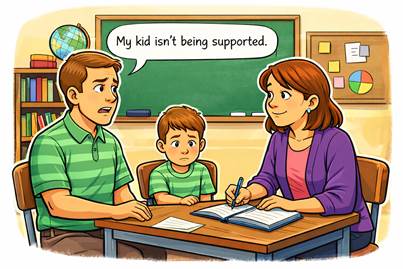
In parent meetings, the issue has often been building before the conversation even begins. By the time the parent speaks, there is usually a mix of concern, frustration, and a sense that something is not right, even if it has not yet been clearly articulated.
“My child is not being supported in class.”
Statements like this are significant, but they are also broad. Moving too quickly to reassurance or action can lead to misunderstanding or further frustration if the underlying issue has not been fully explored.
An effective leader slows the conversation and focuses on building clarity.
– What has your child said is happening?
– What part of the day does your child feel least supported?
– What work is your child finding difficult at the moment?
– How long has this been a concern from your perspective?
– What would support look like for your child?
As the parent responds, the conversation becomes more grounded in specific examples rather than general perceptions. This allows both parties to move from assumption to shared understanding.
At the same time, the act of listening carefully and asking considered questions signals to the parent that their concern is being taken seriously. This reduces tension and builds trust, which is critical if the conversation is to move forward in a constructive way.
**Teacher Development Conversation**
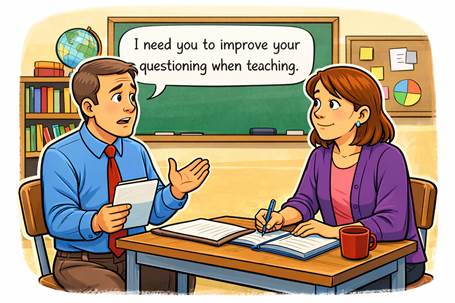
In coaching and performance conversations, clarity is often the difference between feedback that is heard and feedback that leads to change. Without it, even well intentioned advice can fall flat.
“I need you to improve your questioning.”
While the intent is to support improvement, the statement is too broad to guide action. Without a clear picture of current practice, the teacher is left to interpret what improvement looks like and where to begin.
An effective leader approaches this differently by first building a detailed understanding of what is currently happening in the classroom.
– What types of questions are you currently using?
– How are students responding to those questions?
– What part of the lesson are you using them most?
– What do you want students to be thinking about at that point?
– How do you know if your questioning is working?
These questions shift the focus from judgement to understanding. As the teacher reflects, both the leader and the teacher begin to see the same patterns, strengths, and areas for development.
Once that shared understanding is established, any feedback or next steps are grounded in evidence and aligned to the reality of the classroom. This makes improvement more targeted and more likely to be sustained.
**Why This Stage Matters**
This stage takes time, and that is the point. In schools, there is constant pressure to move quickly, solve issues, and move on. However, speed without clarity creates repetition, and leaders often find themselves revisiting the same problems multiple times.
Strong leaders take a deliberate approach. They slow the conversation down before they speed it up, recognising that clarity at the beginning leads to efficiency later. Once a problem is clearly understood, the options generated are more precise, agreement is easier to reach, and actions are more effective.
**Earning the Right to Solve**
Before we move to generating options, we must earn the right to solve. That right comes from understanding. When people feel heard and when the problem is clearly defined, the conversation becomes focused, collaborative, and productive.
Most importantly, it leads to solutions that actually work.
In the next article, we move from clarity to generating multiple options, ensuring we do not default to the first solution, but instead identify the solution most likely to lead to improvement.
Disclaimer: This article draws on more than 20 years of experience working in schools, as well as the work of Allan Parker and other experts who have shaped my thinking around conversations, leadership, and problem solving.
Michael Patane


Leave a Reply