
In the previous article, Active Listening Through Questioning: The First Step to Solving Problems Well, the focus was on building clarity. Strong conversations begin with understanding, and without it, solutions are based on assumption rather than accuracy.
Once clarity has been established, the conversation must deliberately shift. This is the point where many leaders move too quickly. A clear problem is identified, and the first reasonable solution is accepted. It feels efficient, but it often leads to narrow thinking and inconsistent results.
In schools, this often sounds like a quick fix. A behaviour issue leads to a standard consequence, a parent concern leads to reassurance, and a teacher development conversation leads to a single piece of advice. Each of these responses may have merit, but they are often limited because they are based on the first available idea rather than the best possible one.
If we want better outcomes, we must resist the instinct to settle early. The next step is not to find an answer, but to generate multiple options.
Why Generating Options Matters
The first solution is rarely the best solution. It is simply the most immediate, and in busy school environments, there is constant pressure to act quickly. Leaders are expected to solve problems, provide direction, and move forward.
Over time, this creates habits where people rely on what has worked before or what feels easiest to implement, rather than what is most effective in the current context.
When only one option is considered, thinking becomes narrow and the conversation shifts from exploration to justification. Time is spent defending the idea rather than testing whether it is the right one.
Generating multiple options disrupts this pattern. It forces both parties to step back from the first idea and consider alternatives. It creates cognitive stretch, challenges assumptions about what is possible, and opens up different ways of approaching the same issue.
Most importantly, it creates choice. And choice is what allows leaders to select a response that is not just workable, but effective, sustainable, and aligned to the desired outcome.
The Discipline of Option Generation
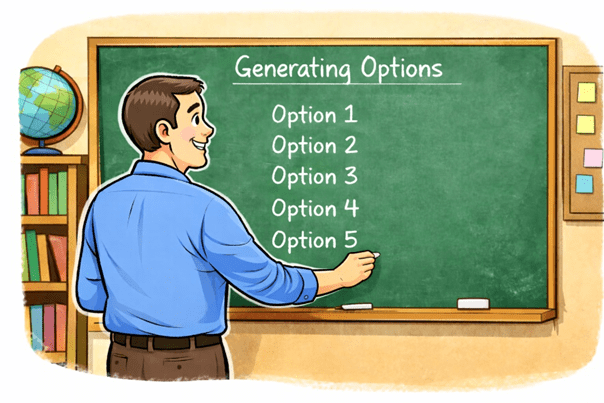
Option generation is not a natural habit. It requires discipline and intent.
Once clarity is achieved, both parties must deliberately remain in the thinking space rather than moving prematurely to action. This is often uncomfortable because the problem is clear, the pressure to act is present, and the solution feels within reach.
Strong leaders recognise this moment and resist the urge to close the conversation too early. Instead, they extend it, ensuring that thinking continues before decisions are made.
A minimum of five options should be generated. Nine is better.
This is not an arbitrary number. It is a forcing function that pushes thinking beyond the obvious and prevents early closure.
The first two or three options are typically predictable. They reflect current practice, familiar strategies, or past responses. It is the options that follow where thinking begins to shift. New ideas emerge, different approaches are considered, and the conversation moves from what we usually do to what we could do.
This is where the real value lies.
The Role of Questions in Generating Options
As in the first stage, questioning remains critical. The quality of the options generated is directly linked to the quality of the questions asked.
The key question remains:
What do we want to see?
From there, questioning expands thinking:
- What are some different ways we could approach this?
- What could we try that we have not tried before?
- How else could this be addressed?
- What would this look like if it was working well?
- What might be a completely different way to solve this?
- What would happen if we did nothing differently?
- What small change could make the biggest difference?
Real Examples in Practice
As with active listening, option generation applies across all key conversations in schools. The difference now is that the conversation has moved from understanding to possibility.
At this point, the problem has already been clarified. It is no longer broad or vague, but specific, observable, and understood by both parties.
Behaviour Concern in a Classroom
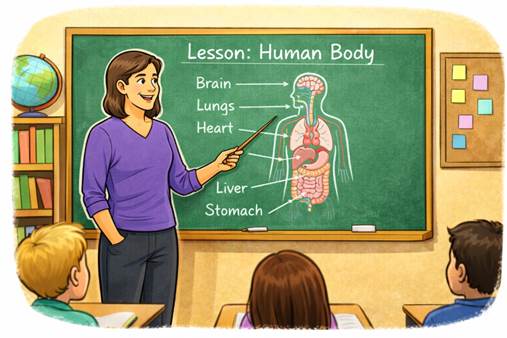
Following the earlier stage of questioning, the issue has been clearly defined. It is no longer “an unsettled class,” but something specific, such as a small group of students arriving late from lunch and disrupting the start of a task.
With that clarity established, the conversation can now shift to generating options.
- Adjusting the structure of the lesson start to engage students immediately
- Establishing a clear and consistent entry routine
- Pre correcting expectations before the break
- Providing targeted follow up for repeated lateness
- Using a short, high engagement task to settle the class
- Positioning the teacher at the door to intercept students
- Reviewing the transition from lunch to learning
Parent Concern

In the earlier stage, the concern has been unpacked and clarified. The conversation has moved beyond a broad statement to a shared understanding of what is happening and where.
With that clarity in place, the focus shifts to what can be done.
- Adjusting classroom support
- Providing additional scaffolding
- Increasing home school communication
- Setting short term goals
- Monitoring progress
- Involving additional support
Teacher Development Conversation

Through questioning in the first stage, a clear picture of current practice has been established.
With that clarity, the focus shifts to development.
- Planning key questions in advance
- Using open and closed questions
- Targeting a wider range of students
- Building in wait time
- Using follow up questions
- Incorporating partner talk
- Reviewing student responses
Avoiding Early Closure
One of the greatest risks in this stage is early closure, where a conversation settles on an option too quickly because it feels practical or familiar.
Strong leaders deliberately extend the thinking by continuing to ask what else could be done, what has not yet been considered, and which option is most likely to have the greatest impact.
From Options to Agreement
Generating options is not the end point. It is the bridge between clarity and action.
Once a range of options has been developed, the conversation moves from possibility to decision. This creates the conditions for a more deliberate and informed agreement.
In the next article, we move from generating options to selecting the most effective path forward.
Disclaimer: This article draws on more than 20 years of experience working in schools, as well as the work of Allan Parker and other experts who have shaped my thinking around conversations, leadership, and problem solving.
Michael Patane

 The Primary Principal - Michael Patane
Leave a comment