
In the previous article, Generating Multiple Options: Moving Beyond the First Answer, the focus was on expanding thinking. Once a problem has been clearly understood, strong leaders resist the instinct to settle on the first solution and instead generate multiple options. This stage matters because it creates choice. Without choice, decisions are limited. With choice, decisions can be deliberate, considered, and aligned to the outcome we are trying to achieve.
However, generating options is not the end of the work. At some point, the conversation must shift again, moving from possibility to decision. This is where many conversations begin to lose their impact. Options have been explored, ideas have been shared, and there is often a sense of momentum. Yet instead of slowing down and securing agreement, the conversation speeds up. A direction is suggested, acknowledged, and the moment passes. On the surface, it feels productive. In reality, nothing has been firmly established.
Agreement is therefore critical. It is the point where a conversation shifts from exploration to commitment, and where both people move beyond discussion to a shared understanding of what will happen next.
Why Agreement Matters
Agreement is often assumed rather than deliberately built. A leader suggests a direction, the other person nods, and the conversation moves on. It sounds like alignment, with responses such as “I’ll give that a go” or “That makes sense.” While these responses signal intent, they rarely provide precision. If both people left the conversation and were asked to describe exactly what will happen next, how it will look in practice, and what success will involve, the answers would likely differ.
This lack of precision creates inconsistency. One person may move forward with a clear picture, while the other operates with only a partial or different understanding. Over time, this leads to uneven implementation and limited impact. Strong agreement removes this ambiguity by creating alignment not just in what will be done, but in why it matters and what success will look like. It ensures that both people are working towards the same outcome in a consistent way. In this sense, agreement is what turns a conversation into a commitment.
Moving from Options to Decision
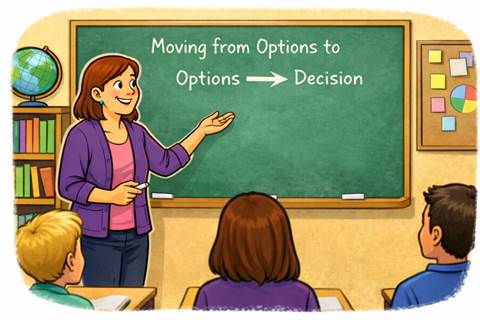
Once a range of options has been generated, the conversation must deliberately slow down. The goal is no longer to create ideas, but to evaluate them against the agreed outcome. Strong leaders guide this shift by anchoring the discussion in impact rather than preference. Questions such as what option is most likely to lead to what we want to see, and how a particular approach will improve the situation described earlier, help both parties remain focused on the intended outcome.
Without this discipline, decisions are often driven by what feels easiest, most familiar, or quickest to implement. With it, the decision becomes intentional and grounded in the clarity that has already been established. This stage requires patience, as the quality of the decision will directly influence the effectiveness of the action that follows.
What Strong Agreement Looks Like
Agreement extends beyond simply selecting an option. It requires both people to leave the conversation holding the same, clear picture of what will happen next. This involves clarity across three key elements. First, there must be clarity of the decision itself, with both people able to articulate what has been agreed and why it has been chosen. Second, there must be clarity of the outcome, ensuring that both understand what success will look like in practice. Third, there must be clarity of commitment, where both parties are aligned in their intent to follow through.
Disciplined questioning remains central at this stage. Leaders continue to test agreement rather than assume it by asking what the agreed approach will look like in practice, how it will differ from current practice, and what evidence will indicate success. Agreement is reached when both people can describe the same future moment with enough detail that it can be recognised when it occurs.
Real Examples in Practice

At this stage of the conversation, the problem has been clearly defined and multiple options have been explored. The work now is to select the most effective path forward and secure agreement around it.

In a classroom behaviour scenario, a teacher may be experiencing an unsettled start to lessons, with students entering without structure and low level disruption impacting learning time. A range of options may have been discussed, including greeting students at the door, establishing a clear entry routine, and providing a short engagement task. Rather than selecting an option quickly, the leader works with the teacher to evaluate each approach against the desired outcome. Through questioning, the teacher begins to define a clear routine, describing how they will stand at the door, greet each student, direct them to a task displayed on the board, and ensure engagement within the first few minutes of the lesson. The conversation continues until the teacher can clearly articulate what they will do, what students will do, and how they will recognise success. Agreement is reached when both share that same understanding.

In a parent conversation, clarity and agreement are equally important. A parent may be concerned that their child is not being adequately supported. After building understanding and exploring possible responses, the focus shifts to aligning on a clear path forward. The leader works with the parent to define what improvement will look like, what actions the school will take, and how progress will be communicated. This moves the conversation beyond reassurance and into a shared commitment. The parent leaves with a clear understanding of what will happen, what success will involve, and how they will be kept informed.

In a teacher development conversation, agreement provides focus. A teacher working to improve their questioning may have explored several strategies, including increasing wait time and using follow up questions. Rather than attempting to implement multiple changes at once, the leader supports the teacher to identify one or two high impact strategies. Through questioning, the teacher refines their approach and can clearly describe how they will implement it in their next lesson. This clarity reduces overload and increases the likelihood of meaningful improvement.
From Agreement to Action
At this point, the conversation has moved from understanding, to options, to agreement. Both people are clear on what will happen next and why it matters. However, agreement alone does not guarantee impact. Without structure, even well considered decisions can lose momentum over time. The next challenge for leaders is ensuring that agreed actions are translated into consistent practice.
In the next article, the focus will shift to how leaders break agreed actions into clear, sequenced processes and how they maintain focus over time to ensure that improvement is sustained.
From Conversation to Impact
Clarity ensures that the problem is understood, options create choice, and agreement aligns both people around a shared direction. When these elements are strong, conversations move beyond discussion and create the conditions for meaningful action. The next step is ensuring that this action is deliberate, structured, and sustained.
Disclaimer: This article draws on more than 20 years of experience working in schools, as well as the work of Allan Parker and other experts who have shaped my thinking around conversations, leadership, and problem solving.
Michael Patane
 The Primary Principal - Michael Patane
Leave a comment