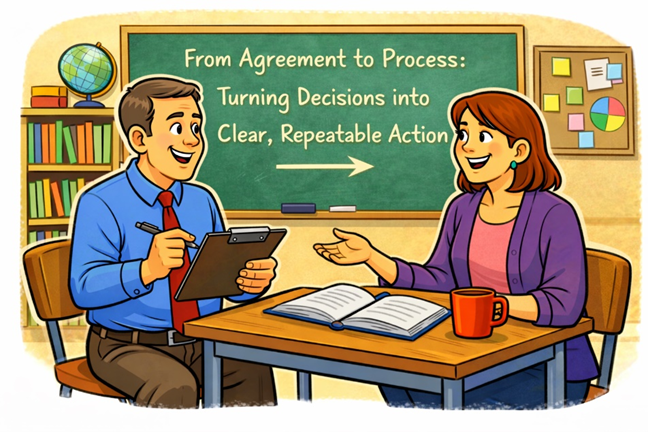
In the previous article, From Options to Agreement: Selecting the Path That Leads to Improvement, the focus was on securing clarity and commitment. Once a problem has been understood and multiple options have been explored, strong leaders guide conversations towards a clear, shared decision. Agreement ensures all parties leave aligned, with a common understanding of what will happen next and what success will look like. However, agreement is not the end point. It is the starting point for action. This is where many conversations lose their impact. A clear decision has been made, all parties are aligned, and there is confidence in the direction. Yet without a clearly defined process, that clarity can quickly dissolve. Good intentions remain, but execution becomes inconsistent. The work of leadership at this point is simple, but disciplined. We must take the agreed direction and turn it into a set of clear, followable steps that can be enacted consistently.
Process is what makes improvement repeatable. Without clearly defined steps, people rely on memory, interpretation, and habit. This creates variation, where one day the approach is applied well and the next it is partial, and over time the impact weakens. Clear steps remove this variability by providing a pathway that can be followed under pressure, in busy classrooms, and in real conversations. They reduce cognitive load and allow the person to focus on doing. Importantly, strong process is not complex. The more effective it is, the simpler it becomes. The goal is not to create more work, but to create clarity. If a process cannot be easily followed, it will not be sustained.

Once agreement has been reached, the conversation must deliberately shift from what we will do to exactly how we will do it. This is where leaders slow the conversation down and begin to build the process step by step. The sequence must be simple enough to remember, clear enough to follow, and specific enough to implement immediately. Leaders guide this through disciplined questioning, focusing on building the steps in order.
Key questions to support this stage include:
- What is the very first thing you will do?
- How will you start this in your next lesson or interaction?
- What happens next?
- How does that lead into the following step?
- What will you do if it does not go to plan?
The conversation continues until the process can be spoken through from beginning to end without hesitation. If it cannot be explained clearly, it is not yet ready to be implemented. A useful discipline at this stage is to keep the process tight, with most effective processes sitting within three to five clear steps, ensuring the work remains focused and manageable.
A critical part of strong leadership at this stage is not just building the steps, but constantly reconnecting those steps to the agreed outcome. This outcome is not just a statement, it is a joint picture that has been built together throughout the entire conversation, from initial clarity through to agreement. All parties should be able to see it, describe it, and recognise it when it occurs. As each step is developed, leaders bring the conversation back to that shared picture, ensuring that every action is contributing towards it.
Key questions to keep the process connected to the jointly constructed outcome include:
- What are we trying to see at the end of this?
- How does this step move us closer to that shared picture?
- What will it look like if this is working in practice?
This prevents the process from becoming mechanical and instead keeps it purposeful. Without this connection, there is a risk that the steps are followed but the intent is lost. With it, each action is anchored in the bigger picture, ensuring all parties are not just completing tasks, but working towards a clearly defined outcome they have built together.
A strong process is step based, visible, manageable, and connected. Each action is clearly defined and follows a logical order, all parties can describe the steps and picture them in action, the number of steps is limited to maintain focus, and every step links back to the agreed outcome. Leaders test the strength of the process by asking the person to talk it through from start to finish, describing what they will do first, second, and third, how it will look in real time, and how each step moves them towards what they want to see. When all parties can clearly describe the same sequence and the same outcome, the process is ready.
At this stage of the conversation, the focus is on turning agreement into a clear set of steps that can be followed consistently while continually reconnecting to the shared outcome.

In a classroom behaviour scenario, a teacher may have agreed to establish a structured start to lessons. The leader works with the teacher to map this into a simple, repeatable process where the teacher stands at the door and greets each student, directs them to a task already displayed on the board, and then circulates immediately to ensure all students are engaged. As each step is built, the leader continually brings the conversation back to the shared picture, a calm, focused start where all students are learning within the first few minutes, ensuring the process remains tight, clear, and directly connected to that vision.

In a parent conversation, process creates confidence because after agreeing on how the school will support a student, the leader outlines the steps clearly, such as implementing a targeted support strategy, monitoring progress across the week, and providing a structured update to the parent. At each stage, the leader reconnects to the shared picture of improved learning and clear communication, ensuring the plan is not just understood but trusted.

In a teacher development conversation, process supports precision, where a teacher working to improve questioning may focus on increasing wait time by asking the question and pausing, maintaining the pause to allow thinking time, and then selecting a student and following up. As the steps are defined, the leader continually reconnects to the shared picture of deeper student thinking and more thoughtful responses, keeping the work focused and meaningful.
Once the process is in place, the role of the leader is to ensure it is enacted and refined over time. This involves returning to both the steps and the shared picture by asking what is happening as the steps are followed, how this is impacting what was intended, and what might need to be adjusted to get closer to that outcome. This ongoing connection between process and outcome ensures that the work remains dynamic, where the steps are not followed blindly but are continually shaped by their impact.
Clarity ensures the problem is understood, options create choice, agreement aligns direction, and process turns that direction into clear, repeatable action. When leaders build simple, well defined steps and continually reconnect them to a shared picture of success, improvement becomes far more likely to occur and far more likely to last. Without clear steps, conversations fade, but with them, they lead to consistent, purposeful action.
Closing the Series: From Conversation to Impact

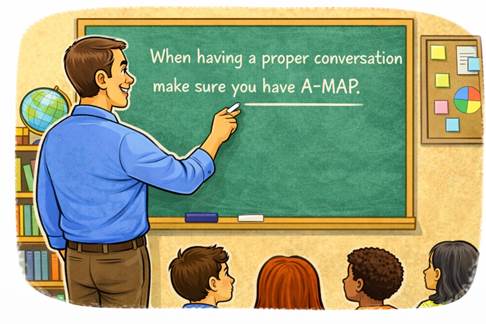
Across this series, the work of leadership has been anchored in a simple but disciplined sequence: A-MAP.
Active Listening is where the work begins. Through disciplined questioning, all parties build a clear understanding of the issue and develop a shared picture of what is happening.
Multiple Options expands the thinking. Rather than settling on the first idea, a range of possible pathways is generated, creating choice and allowing for more deliberate decision making.
Agreement brings alignment. All parties commit to a clear direction and a jointly constructed picture of success that can be described, visualised, and recognised in practice.
Process turns that shared picture into action. The agreed direction is broken into clear, simple, repeatable steps, ensuring that improvement is not left to chance but enacted with consistency.
When these four elements are consistently applied, conversations move beyond discussion and become a structured pathway to improvement. They create clarity where there was confusion, direction where there was uncertainty, and action where there was previously only intention.
Strong conversations are not accidental.
They are led by A-MAP.
Disclaimer: This article draws on more than 20 years of experience working in schools, as well as the work of Allan Parker and other experts who have shaped my thinking around conversations, leadership, and problem solving.
Michael Patane
 The Primary Principal - Michael Patane
Leave a comment