As leaders, we invest significant time developing our conversational skills. We learn how to ask better questions, practise active listening, and guide discussions toward clarity and action. These approaches matter because they improve understanding, strengthen relationships, and increase the likelihood of positive outcomes.
However, there is an important truth that must sit alongside all of this work. No matter how skilled you become, you are only ever part of the equation. You are only 50% of the conversation.

The Illusion of Control
As your skills develop, confidence grows. Conversations begin to feel more structured and purposeful, and outcomes often improve. The challenge is that this progress can create an illusion of control, where it starts to feel like if you execute well enough, every conversation should land where you intend it to.
The reality is that every conversation involves at least two people, and each person brings their own experiences, beliefs, and interpretations into that interaction. Even with a strong process, the outcome is never fully within your control.
The Variables You Do Not Control
There are elements within every conversation that you simply cannot control. Each person brings their prior experiences, belief systems, emotional state, level of trust, and readiness to change. These factors shape how they hear, interpret, and respond within the interaction.
Two people can hear the same words and take away completely different meanings. One person may be ready to move forward, while the other is still processing or protecting their current position. These differences are not always visible, but they are always influencing the conversation.

When the Process Doesn’t Land
There will be moments where you apply your skills with clarity and intent. You ask purposeful questions, you listen actively, you explore options, and you work toward agreement. Despite this, the conversation does not progress in the way you expected.
This is often where frustration begins to build. It is easy to question what went wrong, but more often, something else happens. We shift into a blame mentality.
We start to attribute the breakdown to the other person. We think they are being difficult, resistant, or unreasonable. Over time, this shapes how we see them. Our internal dialogue changes, and that shift does not stay internal. It comes through in tone, body language, and the next interaction.
Left unchecked, this becomes a relationship killer. The focus moves away from solving the problem and toward judging the person. Once that happens, trust erodes, and future conversations become harder, not easier.
The Critical Shift: Focus on Your 50%
The most important shift a leader can make in these moments is to move away from blame and toward responsibility. The work is not in analysing the other person’s behaviour, but in refining your own contribution to the conversation.
This means considering how you can improve your 50%. You might reflect on whether your questions were clear, whether more time was needed to build shared understanding, or whether your approach matched the person in front of you. The focus remains on improving the quality of your input, rather than trying to control the entire interaction.
From 50% to 51%
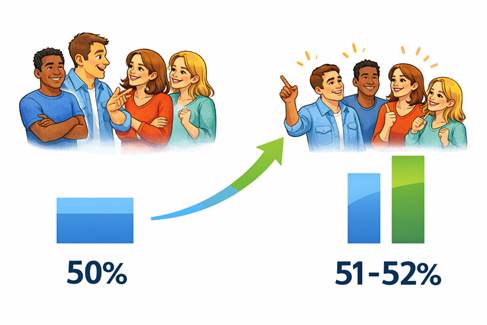
A helpful way to think about this is in small increments. If you are responsible for 50% of the conversation, even a slight improvement in your approach can shift the dynamic. Becoming more aware, more precise, and more adaptive allows you to move from 50% to 51% or 52%.
A critical part of this shift is intent. When you step into that extra one or two percent, your intent must be to hold a positive regard for the person in front of you. You cannot allow frustration or negative feelings to take over.
This does not mean ignoring issues or lowering expectations. It means choosing to see the person as capable, as someone with a perspective worth understanding, even when the conversation is difficult.
When working in that 51% or 52%, there is also a clear discipline. Whatever the original intent of the conversation was, you stay anchored to it. You do not drift into judgement or side issues. Instead, you actively work to surface the other person’s needs.
- What do they need in this situation?
- What is driving their position?
- What outcome are they trying to protect or achieve?
When those needs are surfaced, the conversation shifts. It moves from positions to understanding, and from tension to progress.
These small gains build over time. They strengthen trust, improve clarity, and create the conditions where more conversations lead to positive outcomes. While you cannot control the other person’s contribution, you can influence the direction of the interaction through consistency and intent.
Understanding People, Not Just Process
Frameworks provide structure, but conversations are shaped by people. Emotions, identity, past experiences, and perceived risk all play a role in how individuals engage. These elements influence whether someone is open, cautious, resistant, or uncertain.
Not all personalities respond in predictable ways. Some people are ready to collaborate, while others require more time and trust before they engage fully. There are also exceptions to every pattern, which is why a broad suite of skills is essential. The ability to adapt, read the moment, and respond with intent is what allows leaders to navigate complex conversations effectively.
Holding the Line Without Losing Perspective
There will be conversations that do not resolve cleanly. There will be times where agreement is not reached or where progress is slower than expected. In these moments, it is important to maintain perspective.
You are part of a dynamic system that includes multiple variables, many of which you do not control. Your role is not to guarantee the outcome, but to bring clarity, skill, and purpose to your part of the conversation. When you do this consistently, you increase the likelihood of better outcomes over time.
Closing Thought
Strong leaders focus on the quality of their practice, not just the immediacy of results. By continuing to refine your approach and build your awareness, you strengthen your ability to influence conversations in a meaningful way. At the same time, it is important to hold onto a simple and grounding reminder. You are only 50% of the conversation, and your responsibility is to continually improve your 50% in a way that creates the best possible conditions for progress.
Disclaimer
This article is shaped by my experiences over many years as a school principal, working through complex conversations with staff, students, and community members. It is also influenced by the work of Ken Maclean, whose thinking around leadership and human interaction has informed my approach. The ideas presented here are not intended as a fixed formula, but as practical reflections to support ongoing growth in how we engage with others.


Leave a Reply