In Series One of Conversational Leadership, the focus was on the AMAP framework and the role conversations play in leadership. We explored the importance of active listening through questioning, generating multiple options, reaching agreement, and then building a clear process for implementation.
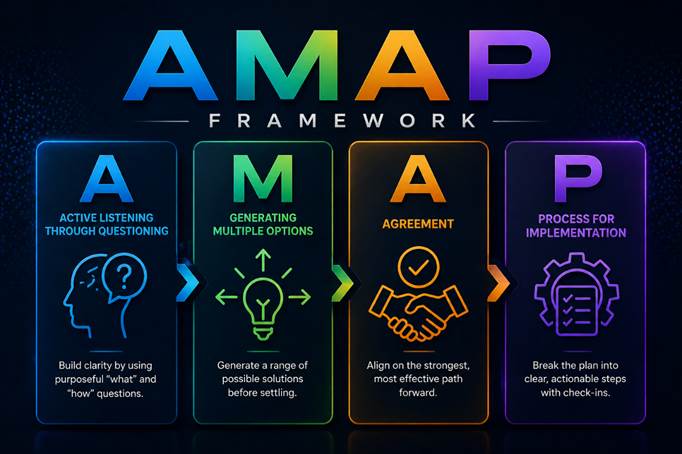
As this work continues, we now begin moving into Series Two of Conversational Leadership. While Series One focused heavily on the AMAP framework itself, Series Two explores the different conversational modes leaders move through when applying the framework in practice. In many ways, this next stage builds directly from the foundations established earlier. Once leaders understand how to create clarity and move toward action, the next challenge becomes understanding what type of conversation is required at different points within the process.
As I have continued reflecting on this work and discussing it with others, I have spent considerable time thinking about the way the terms debate, discussion, and dialogue are interpreted within leadership and professional settings. Many people already hold established academic or professional understandings of these terms and may understandably view them differently depending on their context and experience.
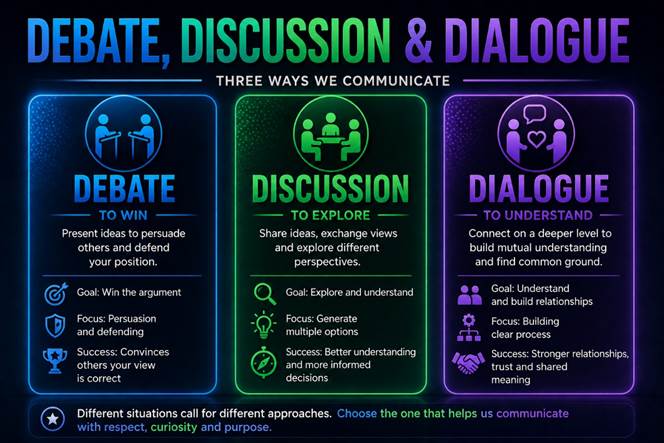
This article is not intended to academically redefine debate, discussion, or dialogue. Instead, it outlines how I interpret and operationalise these conversational modes within education leadership practice and within the AMAP framework.
For me, debate, discussion, and dialogue are not simply interchangeable conversational terms. Within leadership practice, they represent different modes of thinking and different stages of moving from problem identification to implementation.
In practice, leaders constantly move between challenging ideas, generating possibilities, building agreement, and refining implementation. Debate, discussion, and dialogue each serve a different purpose within that process.
• Debate helps challenge assumptions and test thinking.
• Discussion helps generate multiple possibilities and expand options.
• Dialogue helps create alignment, clarity, and practical process for implementation.
For me, conversational leadership is not about remaining in one mode. It is about intentionally recognising what type of conversation is needed at the right time and helping teams move productively between them.
Debate
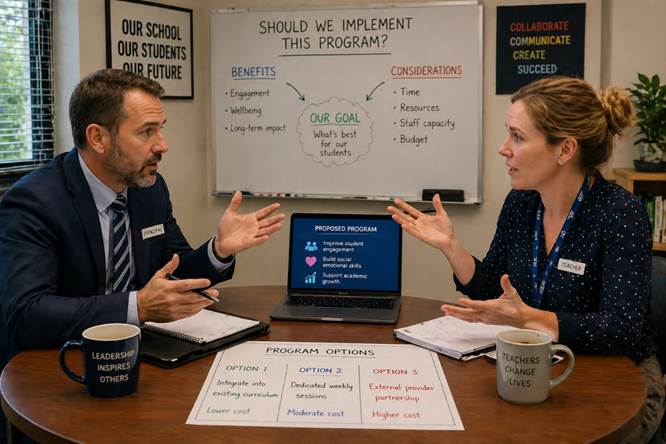
Debate plays an important role in leadership. In schools and organisations, leaders need spaces where ideas can be challenged, assumptions tested, and different perspectives openly explored.
Debate is often energetic and positional. Individuals advocate for their ideas, challenge viewpoints, and attempt to persuade others toward a particular direction. While debate can create tension, it is also useful because it stress tests thinking. Weak ideas are exposed, blind spots emerge, and people are forced to clarify their reasoning.
For example, leadership teams may debate different approaches to behaviour support, curriculum delivery, intervention models, or staff structures. One leader may strongly advocate for consistency and structure, while another may emphasise flexibility and responsiveness. These conversations can sometimes feel uncomfortable, but discomfort is not always negative. Productive debate often forces leaders to articulate why they believe something will work rather than relying on instinct or habit alone.
Debate also helps reveal hidden assumptions within teams. In many schools, long standing practices continue simply because they have always existed. Debate interrupts that pattern. It creates opportunities to ask:
• Why do we do it this way?
• Is this still achieving the outcome we want?
• What evidence supports this approach?
• Are we solving the actual problem or simply responding to symptoms?
In this sense, debate can sharpen thinking and prevent complacency. It can strengthen decision making because ideas are tested before implementation rather than after failure.
Within the AMAP framework, debate often sits closest to the early stages of clarity building. As leaders actively listen and question, differing perspectives naturally emerge. Debate allows those perspectives to be tested openly before teams move toward generating pathways forward.
However, one of the biggest challenges within education leadership is that debate is often overused. In some schools, cultures can unintentionally become dominated by critique, challenge, and positional thinking. Staff meetings, leadership conversations, and professional discussions can slowly shift toward environments where individuals feel they must constantly defend their ideas rather than collaboratively improve them.
While debate has a role in leadership, schools cannot live in debate permanently. Education is deeply relational work, and cultures built primarily around critique, challenge, and positional argument slowly erode trust over time. When teams spend too long defending ideas, people begin protecting themselves rather than improving practice.
In schools where debate dominates, staff can become emotionally exhausted. Conversations become centred on proving, winning, or protecting territory rather than collectively improving outcomes for students. Over time, this can create cautious cultures where people stop contributing openly because they fear criticism, conflict, or public challenge.
Leaders who over rely on debate can unintentionally create cultures where people feel they must constantly justify themselves. Conversations become focused on winning rather than improving. Individuals may begin defending identity and ownership of ideas rather than remaining open to refinement.
This is why leaders must be extremely disciplined about how long teams remain in debate. Debate may sharpen thinking, but it rarely builds collective ownership on its own. If overused, it creates division rather than alignment. Strong leadership therefore requires intentionally moving teams out of critique and into collaborative thinking before cultures become defensive or fragmented.
Debate has value, but it is incomplete on its own. Leadership cannot remain permanently in a state of challenge and critique. At some point, conversations must deliberately move toward possibility, collaboration, and action.
Discussion
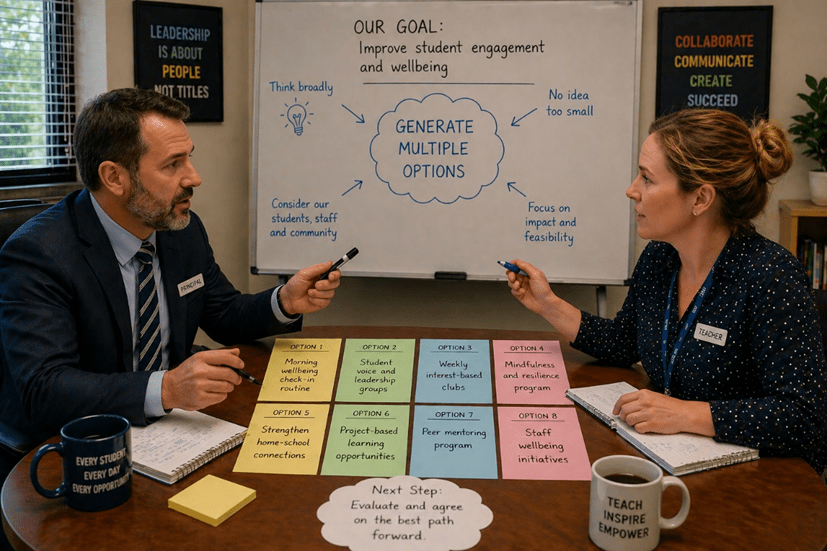
Within the AMAP framework, discussion is where leadership conversations deliberately shift toward generating multiple options.
Once clarity around the issue has been established, the next step is not immediately choosing a solution. Instead, it is about expanding thinking before narrowing it. This stage is important because the first idea is rarely the strongest idea. Often, it is simply the most familiar.
This is the phase where teams begin asking:
• What could we do?
• What are the possible pathways forward?
• What have we not yet considered?
• What would success actually look like?
• What options sit between the extremes?
For me, discussion is collaborative exploration. It is the deliberate process of generating options as a group of two, three, or even an entire team. This directly connects to the “M” within AMAP generating Multiple options before moving toward agreement.
A leadership team, for instance, may discuss multiple ways to improve student attendance, strengthen reading routines, reduce behaviour incidents, or support beginning teachers before deciding on a final direction. During this stage, the goal is not to immediately judge ideas, but to create enough possibilities that genuine choice becomes available.
Strong discussion creates cognitive flexibility. It allows teams to move beyond binary thinking and simplistic either/or solutions. In many cases, the best pathway emerges through combining elements of multiple ideas rather than selecting a single position.
Discussion also increases ownership. When people contribute to generating possibilities, they are more likely to feel connected to the eventual direction. Rather than implementation feeling imposed, it begins to feel shared.
This phase strongly aligns with the middle stages of the AMAP framework. Once leaders have built sufficient clarity through active listening and questioning, discussion expands thinking before agreement begins narrowing the pathway forward.
In many leadership settings, however, this stage is rushed. Teams identify a problem and quickly settle on the first reasonable idea. While this may feel efficient, it often limits innovation, ownership, and long term success. Quick solutions can create the illusion of progress while underlying problems remain unresolved.
Leaders must therefore intentionally protect the discussion phase. This means slowing conversations down long enough for thinking to expand before decisions are narrowed.
Strong discussion widens thinking before narrowing toward action.
Dialogue
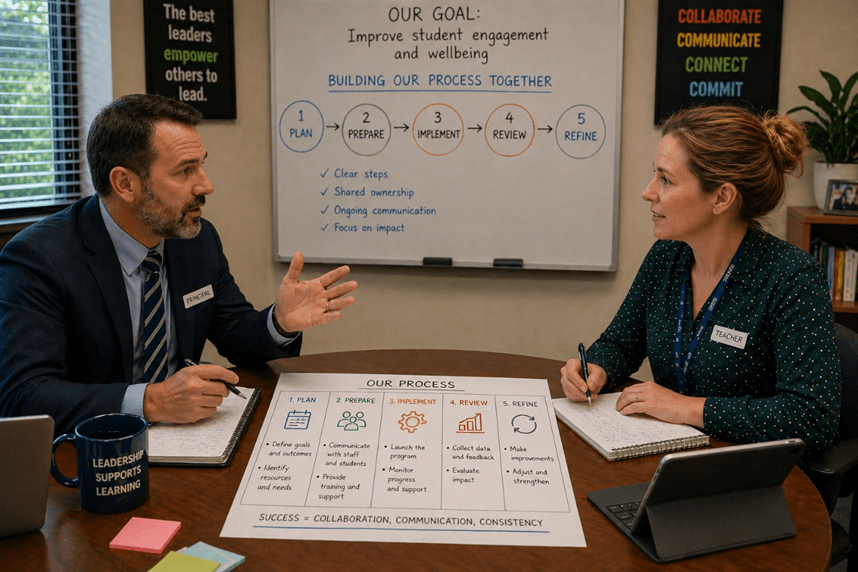
Dialogue sits differently within the A-MAP framework than debate, discussion, or process. For me, dialogue is not primarily about reaching agreement or organising implementation. Dialogue is the disciplined process of helping people think together by surfacing assumptions, perspectives, interpretations, and tensions before teams move toward action.
Within schools, one of the greatest risks in leadership conversations is that people appear aligned on the surface while internally holding very different understandings of the issue, the problem, or the intended direction. Dialogue helps expose this variability early by slowing conversations down and creating space for deeper exploration and shared meaning making.
Within the A-MAP framework, dialogue is heavily connected to Active Listening and Multiple Options. Active Listening creates the conditions for dialogue by helping leaders genuinely hear not only the facts being presented, but also the feelings, perceptions, concerns, and assumptions sitting underneath the conversation. Multiple Options then creates space for teams to explore possibilities, challenge thinking, and test alternative perspectives without prematurely moving toward closure.
For me, dialogue is where leaders become curious rather than reactive. It is where teams collectively pull apart thinking before attempting to solve the problem. Unlike debate, which often focuses on defending positions, dialogue focuses on understanding perspectives and building collective clarity.
This stage of conversation often sounds like:
• Help me understand your thinking around that.
• What assumptions might we be making?
• What could we be missing here?
• Why do different people see this issue differently?
• What tensions are emerging underneath this conversation?
• What concerns are people holding that may not yet be visible?
• What perceptions are influencing the way this issue is being interpreted?
• Are we solving the right problem?
• What other perspectives should we consider before moving forward?
The purpose of dialogue is not immediate agreement. The purpose is collective understanding. Dialogue helps teams build shared mental models before decisions are made or implementation begins. This is critical because many organisational problems emerge when teams move too quickly into action without first developing clarity around the issue itself.
Dialogue also helps separate facts, feelings, and perceptions within leadership conversations. Often teams become stuck because assumptions and emotions are being treated as objective truth. Through disciplined questioning and active listening, dialogue helps bring these elements to the surface so they can be acknowledged, clarified, and explored productively.
For example, a school leadership team discussing student behaviour may initially believe they are aligned around the issue. However, through dialogue, deeper differences may emerge around teacher expectations, perceptions of consistency, assumptions about student engagement, or differing beliefs about accountability and support. Without dialogue, these tensions often remain hidden and later undermine implementation.
Importantly, dialogue requires leaders to tolerate ambiguity and resist rushing prematurely toward solutions. Leaders must create enough psychological safety for differing perspectives to emerge while also maintaining enough structure for the conversation to remain productive.
Within A-MAP, dialogue does not replace Agreement or Process. Instead, it strengthens them. Dialogue improves the quality of decision making because teams move toward agreement with greater clarity, stronger collective understanding, and fewer hidden assumptions.
In many ways, dialogue is the stage where leadership shifts from telling to understanding. It helps teams think together before they act together, creating stronger foundations for alignment, implementation, and sustainable improvement.
Moving Between Conversational Modes
One of the most important understandings for leaders is that no single conversational mode is always superior.
There are times where debate is necessary to challenge assumptions.
There are times where discussion is necessary to generate multiple possibilities.
here are times where dialogue is necessary to build collective understanding by exploring facts, feelings, perceptions, and differing interpretations before moving toward alignment.
Problems emerge when leaders unintentionally remain stuck in one mode.
Teams that only debate often become divided.
Teams that only discuss can struggle to make decisions.
Teams that move to dialogue too quickly may begin building understanding around a direction before fully exploring better possibilities.
Strong leaders understand how to intentionally move between debate, discussion, and dialogue depending on what the conversation requires. In many ways, this is where Series One and Series Two connect together. The AMAP framework provides the structure for moving from clarity to implementation, while debate, discussion, and dialogue help leaders understand the conversational modes required throughout that journey.
Conversational leadership is not about avoiding disagreement, nor is it about endless conversation. It is about understanding which conversational mode is needed at the right time and then intentionally helping teams move toward clarity, ownership, and action.
Ultimately, leadership is not just about talking more. It is about understanding how different forms of conversation shape thinking, ownership, clarity, and action.
And perhaps that is one of the most important parts of conversational leadership itself.
Disclaimer: This article draws on more than 20 years of experience working in schools, as well as the work of Allan Parker and other experts who have shaped my thinking around conversations, leadership, and problem solving.
Michael Patane
 The Primary Principal - Michael Patane
Leave a comment