
One of the questions I find myself asking more often as I get older is, “Is this a hill I want to die on?”
We have all been there. Someone makes a decision we disagree with. An email arrives that rubs us the wrong way. A process changes and suddenly we find ourselves thinking, “That makes no sense.” Before long, we are talking about it with colleagues, replaying the situation in our heads and building a case for why we are right.
The interesting thing is that most of these issues are not actually about the issue itself. They are often about our perception of the issue and the emotional response we have attached to it.
When we become frustrated, we naturally move into what Allan Parker would describe as first position. In first position, we are viewing the situation entirely through our own lens and, more importantly, through our own feelings. We know how we feel, we know what we believe should have happened and we know why we think we are right. The challenge is that when we are operating from first position, our emotions can magnify the issue. A small procedural change can feel like a major organisational failure. A passing comment can feel like a personal attack. A disagreement can feel like a battle that must be won.
The problem is that emotional intensity can trick us into believing something is more important than it actually is. The fact that we feel strongly about an issue does not automatically make it a hill worth dying on. Sometimes it simply means we are seeing the situation from one position and one position only.

This is often where people become stuck in debate.
In an earlier article, I wrote about the differences between debate, discussion and dialogue. Debate has an important role. It allows ideas to be challenged and assumptions to be tested. Healthy organisations need people who are prepared to ask difficult questions and challenge thinking.
However, debate becomes problematic when it becomes the destination rather than a stage in the process. People become attached to their position. The goal shifts from understanding to winning. The conversation becomes less about solving a problem and more about proving a point.
Once that happens, progress slows.
What I have noticed is that people who become stuck in debate are often stuck in time as well. Their thinking remains anchored in the past. Conversations revolve around what happened, who said what, who should have done something differently and why the situation should never have occurred in the first place.
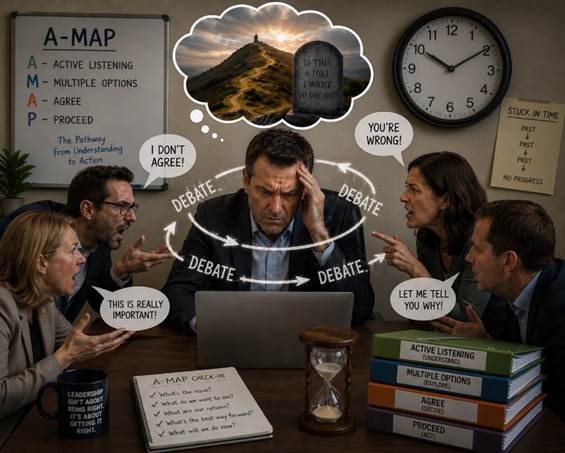
There is certainly value in understanding the past. The past helps us identify causes, patterns and lessons. However, spending too much time there can leave us trapped. The past can explain why a problem exists, but it rarely tells us how to solve it.
This is where A-MAP can help.
At its core, A-MAP helps people move conversations through time. Active Listening allows us to understand the issue and genuinely hear the concerns people bring. It gives people an opportunity to share their facts, feelings and perceptions. It helps us understand what has happened and what people are experiencing right now.
However, effective leaders know that understanding the issue is only the starting point. At some stage, the conversation has to move forward.
The shift occurs when we begin asking different questions. Instead of asking, “Who was right?” we begin asking, “What do we want to see?” Instead of focusing on who made the mistake, we focus on the outcome we are trying to achieve. Instead of replaying the problem, we begin exploring possibilities.
This is where discussion becomes more powerful than debate.
Discussion is about generating options. It is about recognising that there is rarely only one pathway forward. The Multiple Options phase of A-MAP encourages people to think broadly, consider alternatives and create possibilities that may not have been obvious at the beginning of the conversation.
Importantly, discussion moves us into the future. It shifts our attention from what has happened to what could happen next.
Once options have been explored, dialogue can begin. Dialogue is where people build shared understanding, develop agreements and establish clear processes. It is where conversations move from ideas to action.
The goal is no longer to determine who was right. The goal is to determine what happens next.
This is why I find the question, “Is this a hill I want to die on?” so useful.
If the issue involves safety, ethics, values or something that fundamentally affects outcomes for children, then perhaps it is a hill worth standing on. Those conversations require courage. They require advocacy. They require leaders who are prepared to hold their ground.
However, most of the frustrations we encounter each day do not fall into that category. They may be irritating. They may be inconvenient. They may even be important. Yet they are often not important enough to justify becoming trapped in endless debate.
The next time you find yourself frustrated by an issue, pause for a moment and ask yourself a simple question.

Is this a hill I want to die on?
If the answer is yes, then step forward with conviction.
If the answer is no, then stop trying to win the argument. Move beyond debate. Enter discussion. Generate options. Create dialogue. Build agreement. Focus on the future.
After all, the past can explain a problem, but only the future can solve one.
Disclaimer: Many of the ideas referenced in this article have been influenced by the work of Allan Parker. In particular, Allan’s thinking around facts, feelings and perceptions, positional awareness and productive conversations has significantly shaped my own leadership practice. Any interpretations, applications or adaptations presented in this article are my own.


Leave a Reply