Leadership is often described in terms of vision, influence and the ability to inspire others. While these qualities are undoubtedly important, they represent only part of what leaders do each day. Effective leadership requires far more than motivating people or setting strategic direction. It involves understanding the work, creating the conditions for success and building relationships that enable people to perform at their best. In my experience, these responsibilities can be viewed through three interconnected lenses: technical leadership, organizational leadership and conversational leadership.
Exceptional leaders move comfortably between these three forms of leadership. They understand that each serves a different purpose and that sustainable improvement occurs when all three operate together. The challenge for many leaders is that they naturally favour one area over another. Some are highly skilled practitioners with deep technical knowledge, while others excel at organising complex systems or building relationships through conversation. The strongest leaders recognise their preferences but deliberately develop capability across all three domains.
Technical Leadership
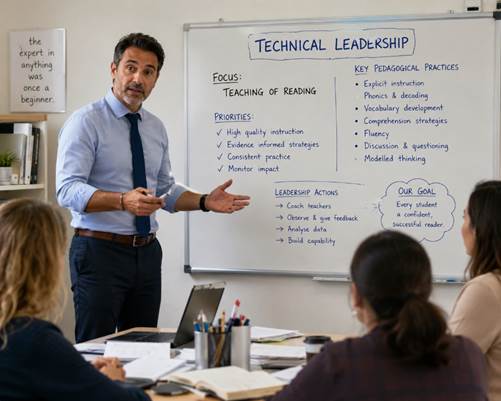
Technical leadership is about understanding the core work of the organisation. In schools, this means having a deep knowledge of teaching, learning, curriculum, assessment, behaviour support and school improvement. It requires leaders to remain engaged with current research while continually refining their own understanding of effective practice.
Technical expertise provides leaders with credibility. Teachers are far more likely to engage with feedback when they believe the person providing it genuinely understands the complexity of classroom practice. Rather than relying solely on positional authority, technical leaders earn professional trust because they can discuss evidence, model effective practice and ask questions that improve teaching.
Importantly, technical leadership is not about having all the answers. Education is constantly evolving, and effective leaders recognise that their own learning never finishes. They remain curious, seek out new evidence and are willing to adapt their thinking when better approaches emerge. By modelling continuous learning themselves, they create a culture where professional growth is valued across the entire school.
Organisational Leadership
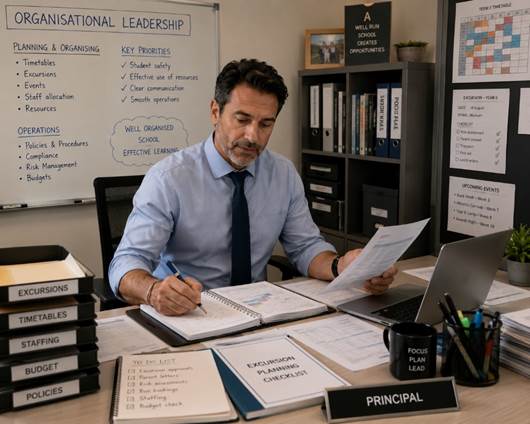
Even the most effective teaching practices will struggle to succeed if they are not supported by sound organisational structures. Organisational leadership focuses on designing the systems, processes and conditions that allow people to do their best work. It is concerned with moving beyond isolated initiatives and ensuring that improvement is sustainable.
Schools are among the most complex organisations to lead. Principals and leadership teams manage staffing, budgets, facilities, compliance, community expectations and student wellbeing while simultaneously maintaining a relentless focus on teaching and learning. Without effective organisational leadership, even highly capable staff can become overwhelmed by competing priorities and unnecessary complexity.
Strong organisational leaders create clarity. They establish clear priorities, align resources with strategic goals and develop systems that reduce duplication rather than increase workload. Meetings become purposeful, communication becomes consistent and staff understand both what is expected and why it matters. When these structures operate effectively, schools often feel calm, focused and purposeful, even during periods of significant change.
Conversational Leadership
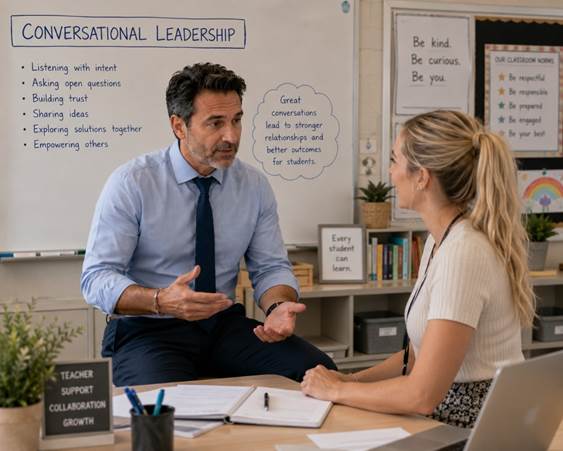
While technical expertise and organisational systems are essential, neither achieves lasting improvement without effective communication. Leadership is ultimately exercised through conversations. Every interaction with staff, students, parents and the wider community has the potential to build trust, create clarity or strengthen relationships.
Conversational leadership is founded on listening as much as speaking. Effective leaders ask thoughtful questions, seek to understand different perspectives and create opportunities for genuine dialogue. Rather than relying on persuasion alone, they involve others in the process of understanding challenges and developing solutions. These conversations build commitment because people feel heard, respected and valued.
Many of the challenges that emerge in organisations are, at their core, conversational issues. Performance concerns often persist because difficult conversations have been avoided. Misunderstandings develop when expectations have not been clearly communicated. Cultural issues frequently arise when leaders fail to create opportunities for open and honest dialogue. Addressing these conversations early and respectfully strengthens both relationships and organisational performance.
Bringing the Three Together
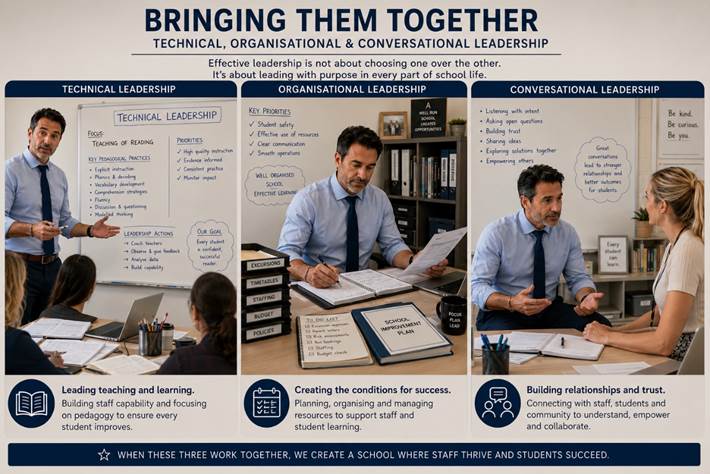
The true strength of these leadership dimensions lies in their integration. Consider the introduction of a new whole school reading approach. Technical leadership enables leaders to understand the evidence behind the initiative and identify what effective classroom implementation should look like. Organisational leadership ensures that professional learning, coaching, resources and timelines are aligned to support successful implementation. Conversational leadership then creates the commitment required for change by addressing concerns, building understanding and fostering collective ownership.
When one of these dimensions is missing, improvement becomes significantly more difficult. Technical expertise without effective organisation often results in frustration because good ideas lack the structures needed for implementation. Strong organisational systems without meaningful conversations may achieve compliance but rarely generate genuine commitment. Likewise, excellent communication without technical knowledge can inspire people temporarily but ultimately lacks the professional depth required to improve outcomes.
Leading With Balance
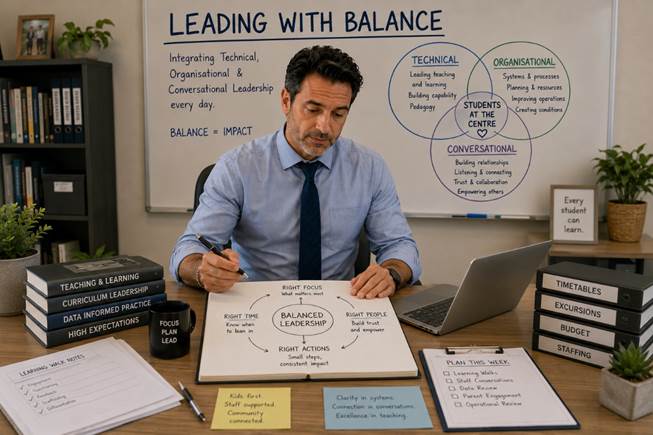
One of the defining characteristics of highly effective leaders is their ability to recognise which form of leadership is required at any given time. A classroom observation may require technical expertise to provide meaningful feedback on instructional practice. Budget planning demands organisational thinking to ensure resources are aligned with strategic priorities. A challenging parent meeting or difficult staff conversation calls upon conversational leadership to build trust while maintaining high expectations.
Rather than asking which leadership style is most important, leaders should ask which leadership challenge they are trying to solve. The answer will often determine which capability needs to be emphasised while still drawing upon the other two.
Reflecting on Leadership
Reflection provides an opportunity to maintain balance across these three domains. Leaders might ask themselves whether they have developed their own professional expertise, improved the systems that support others or invested time in the conversations that strengthen relationships. These questions encourage leaders to look beyond immediate operational demands and consider whether they are growing across all aspects of leadership.
Leadership is not simply about making decisions or directing others. It is about building the capability of individuals and creating organisations where people can succeed together. Technical leadership develops professional expertise, organisational leadership creates the structures that enable improvement and conversational leadership builds the trust that allows change to occur. When these three dimensions work together, leaders create schools that are not only effective but also places where people feel supported, valued and inspired to continually improve.
Michael Patane


Leave a Reply