One of the most common mistakes leaders make when implementing change is also one of the easiest to understand: we rely on our experience. When we see a problem, we naturally reach into our professional memory and ask ourselves what we have seen before, what worked last time and what we would do in this situation. There is nothing inherently wrong with this. Experience matters, and over time good leaders develop pattern recognition, anticipate problems earlier and build an instinct for what might work.
The problem occurs when experience becomes the entire change process. Our experience only represents the places we have worked, the people we have worked with, the successes and failures we have personally witnessed and the opportunities we have had to learn. No matter how experienced we become, that will always represent a tiny fraction of what is possible. Experience tells us what we know, but it cannot tell us what we don’t know.
That is where one of the great challenges of leadership sits: we don’t know what we don’t know. If our entire change process is based on our previous experience, we can unknowingly limit an organisation to the boundaries of our own knowledge. We might make things better, but we may never discover that somewhere else somebody has already found a significantly better way.
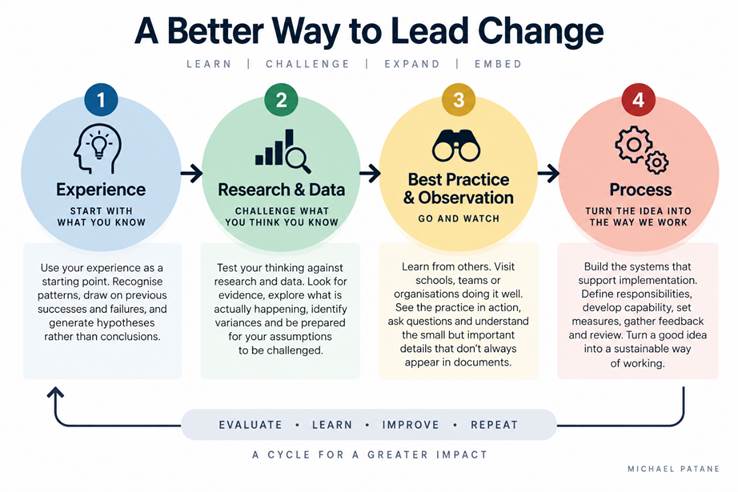
For me, a strong change process needs to move through four areas: experience, research and data, best practice and observation, and process. None of these areas should operate independently. Together, they provide a way of challenging what we think we know, discovering what we don’t know and ultimately building change that is more likely to make a sustained difference.
1. Experience: Start With What You Know
Experience should absolutely be part of the change process because it gives us a starting point. Experienced leaders recognise patterns, understand people, anticipate barriers and can draw upon previous successes and failures. The longer we lead, the larger this professional library becomes, and ignoring that knowledge would make little sense.
The important distinction is that experience should generate hypotheses rather than conclusions. Instead of thinking, I’ve seen this before, so I know what we need to do, the question becomes, I’ve seen something like this before, so what does my experience suggest and what else do I need to understand before we act? That small shift moves experience from being the answer to being the beginning of the investigation.
2. Research and Data: Challenge What You Think You Know
Once we have an initial view of the problem, we need to test it against something beyond ourselves. Research allows us to access knowledge generated across thousands of classrooms, schools, organisations and contexts, while data allows us to test that knowledge against what is actually happening in our own environment. Together, they help protect us from making decisions simply because something feels right or worked somewhere else.
This requires leaders to genuinely interrogate the evidence rather than searching for information that confirms a decision they have already made. What is actually happening? Where is the variance? Who is succeeding and why? Who is struggling? What has changed over time? Sometimes the evidence confirms our experience and sometimes it challenges it, but both outcomes are valuable because good change doesn’t use data to justify a decision; it uses data to improve the decision.
3. Best Practice: Go and Watch
Research can tell us a great deal, but there is another step that I think is massively underused in leadership: go and look. If another school, team or organisation is doing something exceptionally well, there is enormous value in getting out of your own environment and seeing that practice in action. Too often we attempt to recreate excellence from a document, presentation or description when we could simply go and watch the people who are already doing it.
Research can tell you what works, but observation can help you understand how it works. A strategy described on paper can appear remarkably simple until you see it operating successfully and realise there are dozens of small behaviours, routines, expectations, conversations and systems sitting underneath it. These are often the things that are difficult to capture in a policy, framework or research paper, yet they can be the difference between successful implementation and another initiative that disappears after twelve months.
This is also where we begin discovering what we didn’t know that we didn’t know. Ask questions, watch the process, talk to the people doing the work, examine the artefacts and notice the small things. The purpose isn’t to blindly copy another organisation; it is to understand why their approach works and then determine which elements can be adapted to your own context.
4. Process: Turn the Idea Into the Way We Work
The final area is process, and this is often where good ideas succeed or fail. A good idea is not a change strategy, and neither is a presentation, professional development session, new document or announcement at a staff meeting. If we want something to become embedded practice, we need to deliberately build the processes that will support it.
That means thinking beyond what are we going to do? and asking how the change will actually operate. Who is responsible? What capability needs to be developed? What does successful implementation look like? How will people receive feedback? What will we measure? How will we know whether the agreed practice is actually occurring? When will we review it, and what will we do when the evidence tells us something isn’t working?
Without process, change depends heavily on individual enthusiasm, memory and goodwill. Those things can help launch change, but they rarely sustain it. Process turns a good idea into a system, and eventually that system becomes simply the way we work.
Change Should Be a Cycle, Not a Decision
For me, strong change increasingly looks like this: Experience → Research & Data → Best Practice & Observation → Process. Experience gives us somewhere to start, research and data challenge and sharpen our thinking, observing best practice expands our understanding of what is possible, and process turns that understanding into sustained action. Once implemented, we evaluate the impact, learn from what happened and allow that new experience to become the starting point for the next cycle.
The danger for experienced leaders is believing that because we have seen a lot, we have seen everything. In fact, greater experience can sometimes make us more vulnerable to this assumption because we become increasingly confident in our ability to recognise patterns and solve problems. The challenge is to retain the confidence that comes from experience while maintaining enough curiosity to accept that there may be a better way we simply haven’t encountered yet.
Perhaps leadership maturity isn’t about accumulating enough experience that we eventually have all the answers. Perhaps it is about accumulating enough experience to understand that our own experience will always be incomplete. The best leaders therefore don’t stop at what they know; they deliberately create processes that expose themselves and their organisations to what they don’t know.
Experience is powerful, but it should open the investigation rather than close it. The moment our experience becomes the only reason for change is the moment we risk limiting our organisation to the boundaries of what we already know.
Michael Patane


Leave a comment