Leadership is full of moments where you are given the opportunity to speak. Staff meetings, conferences, assemblies, presentations, briefings and conversations with your team. Sometimes you have an hour. Sometimes you have twenty minutes. But often, you have far less time than you think.
I reckon eight minutes is enough.
Eight minutes is enough to make people think. Eight minutes is enough to remind people why the work matters. Eight minutes is enough to reconnect people with where they have been and, more importantly, where they are going.
But if you only have eight minutes, every word needs to count.
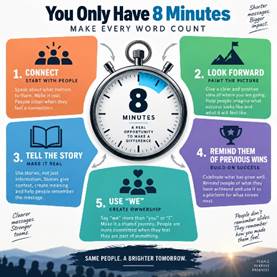
The first thing I think about is connection. Before people will listen to where you want to take them, they need to feel connected to what you are saying. That connection rarely comes from data, slides or another list of priorities. It comes from understanding the people in front of you and talking about something that matters to them.
Good leadership communication should make people recognise themselves in the story.
That is why I think it is important to link what we are saying to previous wins and good times. Every organisation has moments it is proud of. Great results. Difficult challenges that were overcome. Teams that worked incredibly well together. Students whose lives were changed. Moments where people walked away thinking, we did something pretty special there.
Those stories matter because they remind people of what they are capable of.
When we are asking people to move forward, particularly when we are asking them to change, it helps to remind them that they have successfully moved before. We are not pretending that everything in the past was wrong. We are acknowledging what worked, celebrating it and using it as a platform for what comes next.
That is where narrative becomes so important.
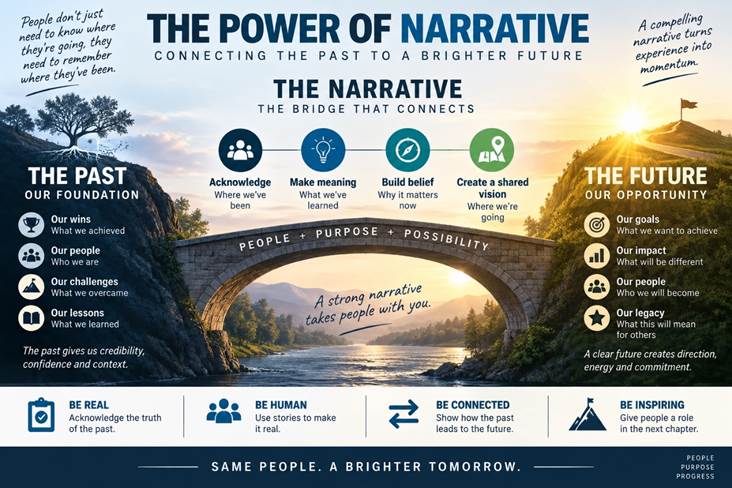
People remember stories far more easily than they remember dot points. A story gives context to the message. It gives people something to attach the idea to. It makes an abstract concept real.
As leaders, sometimes we spend so much time trying to explain everything that we actually make the message harder to understand. We fill presentations with information because we want people to see how much thinking has gone into the work. But the audience doesn’t necessarily need all of our thinking. They need to understand the story.
Where have we been?
Where are we now?
Where are we going?
And why does it matter?
The other thing I have learnt is that leadership communication needs to be future focused. It is easy to spend eight minutes explaining the problem. We can talk about what isn’t working, what the data tells us, what needs to improve and why things need to change. Some of that is necessary, but people also need to be able to see what success looks like.
Paint the picture.
Be detailed about where we are going. Help people imagine what the school, organisation or team will look like when we get there. What will people be doing differently? What will students experience? What will we notice? What will success feel like?
The clearer that picture becomes, the easier it is for people to see themselves in it.
And that leads to something incredibly simple that I think makes a significant difference: use “we” more than “you” or “I.”
Language matters.
“I want us to…” sounds very different from “We are going to…”
“You need to…” sounds very different from “We need to…”
Leadership should create collective ownership. The work cannot belong solely to the leader and it certainly cannot be something the leader simply hands to everybody else. If we are serious about improvement, then it has to become our work.
That doesn’t mean avoiding accountability or pretending that everyone has the same role. Leadership still requires clarity, expectations and difficult conversations. But when we communicate our direction, people should hear that they are part of something rather than simply being told to do something.
Eight minutes isn’t long.
But maybe that is the point.
When you know you only have eight minutes, you stop trying to say everything. You start thinking about what actually matters. You think about the story you want people to remember when they walk out of the room.
Connect with people. Remind them of what they have already achieved. Tell the story. Show them where you are going. And make it our journey rather than yours.
You don’t need an hour to make a difference as a leader.
Sometimes you just need eight minutes.
Make every word count.
Michael Patane


Leave a Reply