One of the things I have learnt about leading change is that having a good idea is the easy part. Most leaders can identify things they would like to improve. We can look at our data, walk through classrooms, listen to our people or observe another organisation and quickly develop a view about what needs to change. The harder part is turning that idea into consistent practice.
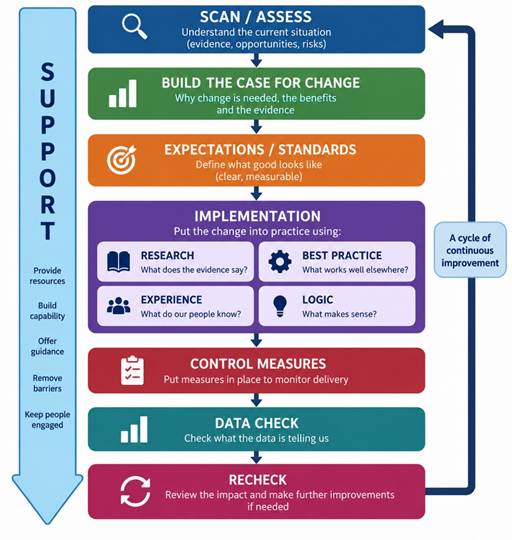
Too often, change becomes an event. We announce a new direction, run some professional learning, provide a resource and assume implementation will follow. When it doesn’t, we can be quick to conclude that people are resistant to change or that the idea wasn’t good enough. I think the problem is often much simpler than that: we didn’t have a process. Over time, I have started to think about change as a cycle with seven interconnected stages: Scan and Assess, Build the Case for Change, Expectations and Standards, Implementation, Control Measures, Data Check and Recheck. Running alongside every stage is something equally important: Support. Each part matters, and skipping one increases the likelihood that a good idea never becomes sustained practice.
Scan and Assess
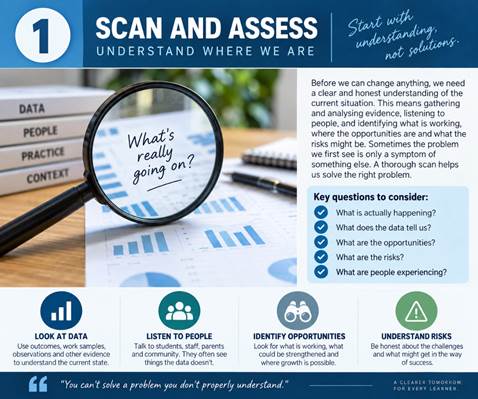
Good change should begin with understanding, not solutions. Before deciding what needs to change, we need to understand the current situation. What is actually happening? What does the evidence tell us? Where are the opportunities? Where are the risks? What are people experiencing? This is where leaders need to resist the temptation to diagnose too quickly, because sometimes the problem we first see is only a symptom of something else.
Data matters here, but data is broader than a spreadsheet. It can include student outcomes, observations, work samples, feedback, conversations, processes and what we see happening every day. It is also important to listen to the people closest to the work because they will often see things that aren’t immediately visible in the numbers. The purpose of scanning isn’t to prove that our preferred solution is right; it is to understand the problem well enough that we are solving the right one.
Build the Case for Change
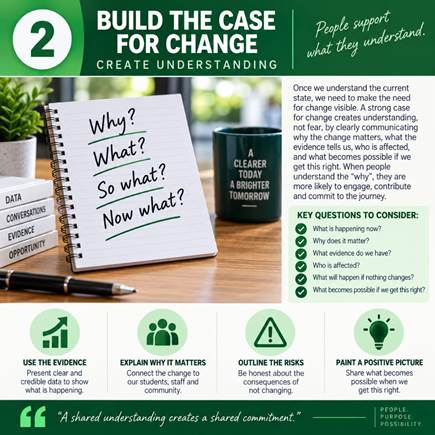
Once we understand the current state, we need to answer the question people quite reasonably ask: Why are we changing? Leaders sometimes underestimate how important this is because we have often spent weeks or months thinking about an issue before we introduce it to everybody else. We have seen the data, had the conversations, read the research and probably replayed the problem in our heads numerous times. Then we stand in front of a group of people who may be hearing about it for the first time and expect them to immediately arrive at the same conclusion.
Building the case means making the need for change visible. What is happening now? Why does it matter? Who is being affected? What evidence do we have? What will happen if nothing changes? Importantly, what becomes possible if we get this right? A compelling case for change shouldn’t manufacture urgency; it should create understanding. People don’t need to be frightened into change. They need to understand why the status quo is no longer good enough and why the proposed direction is worth pursuing.
Expectations and Standards
This is the part of change processes that I think is most commonly underestimated. We tell people what we want to improve but don’t define what good actually looks like. We say things like, “We need better teaching,” “We need greater consistency,” “We need stronger planning,” or “We need to improve reading.” They sound like expectations, but they aren’t. They are aspirations, and aspirations leave far too much room for interpretation.
If we want consistent practice, we have to define the practice. What specifically should people be doing? What would we expect to see? What should students experience? What does the agreed standard look like? The clearer we can make this, the fairer the change process becomes. People shouldn’t have to guess what their leader means by “good”, and leaders shouldn’t be holding people accountable for expectations that were never clearly defined in the first place.
Implementation
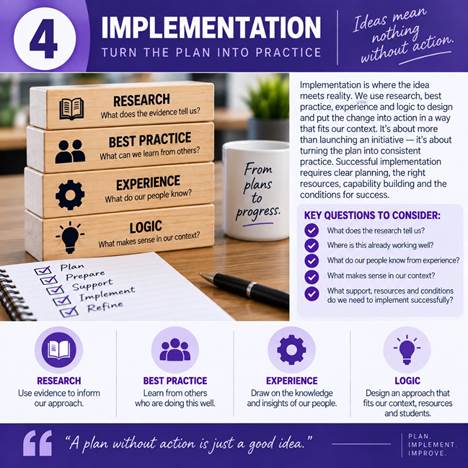
Implementation is where the idea meets reality, and it is also where I think leaders need to be particularly careful about relying solely on their own experience. Experience is incredibly valuable, but it represents only what we have personally encountered. What worked in one school, organisation or context might not necessarily work in another, and our previous experience can sometimes make us overly confident that we already know the answer.
That is why I use four lenses when thinking about implementation: Research, Best Practice, Experience and Logic. Research asks, What does the evidence tell us? Best practice asks, Where is this already being done well, and what can we learn from it? Experience asks, What do our people already know from doing the work? Logic asks, Given our context, resources and people, what actually makes sense?
None of those four is sufficient on its own. Research without context can become theory. Best practice without understanding can become imitation. Experience without challenge can become “that’s how we’ve always done it”, while logic without evidence can simply become opinion. Put the four together and we have a much stronger foundation for implementation. We are testing what we think we know against evidence, learning from others, drawing on the knowledge of our people and then designing something that makes sense in our context. The goal isn’t simply to introduce an idea; it is to turn the idea into the way we work.
Control Measures
This is probably the part of the model I feel most strongly about. Good leaders set expectations; great leaders build control measures around them. A control measure isn’t about controlling people. It is about controlling the implementation of an agreed process and giving ourselves a reliable way of knowing whether what we said was important is actually happening.
If something is important enough to introduce, it should be important enough to check. What evidence will tell us whether the change is actually happening? When will we check? Who will check? What will we do when we find variation? Without control measures, leaders are often left relying on perception. We tell ourselves that we’ve done the training, everyone knows the expectation and we think it is happening, but none of those things provides evidence of implementation.
Control measures close that gap. They might involve learning walks, planning reviews, student work, moderation, observations, feedback, check-ins or other agreed measures depending on the change being implemented. The important thing is that they are identified when we establish the expectation, not invented afterwards when something goes wrong. If people know what good looks like and how we will know whether it is happening, the process becomes clearer and more transparent for everyone.
Data Check
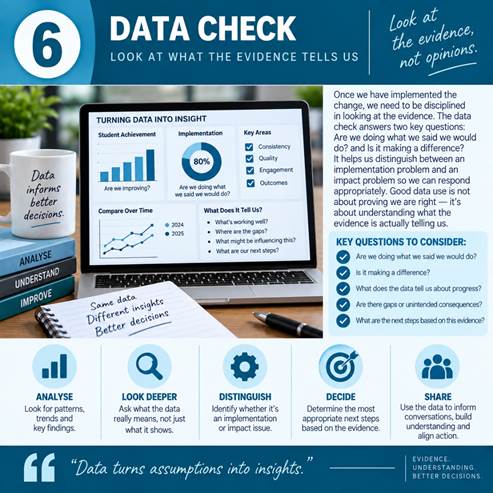
Once implementation is underway, we need to look at what the evidence is telling us. There are really two questions we need to answer: Are we doing what we said we would do, and is it making a difference? Those questions are closely connected, but they are not the same thing, and confusing them can lead leaders to make poor decisions about whether an initiative is working.
A strategy can be implemented consistently and still fail to produce the intended outcome. Equally, we can have a strong strategy that appears ineffective because implementation is inconsistent. That distinction matters enormously. Before abandoning an initiative because the outcomes haven’t changed, leaders need to know whether it was actually implemented as intended. The data check allows us to separate an implementation problem from an impact problem. If implementation is weak, our response may be greater clarity, capability building or support. If implementation is strong but impact remains weak, we may need to reconsider the strategy itself.
Recheck
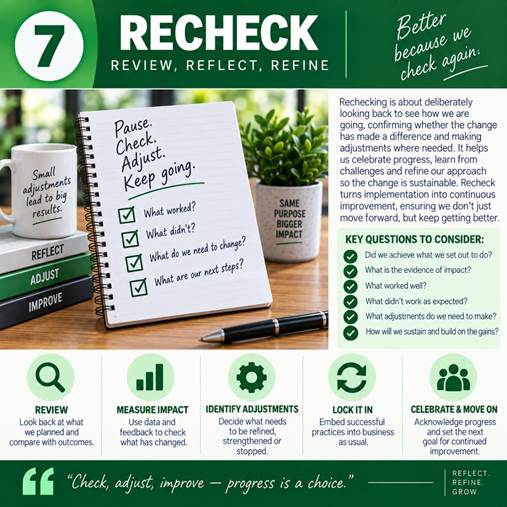
One of the biggest mistakes in improvement work is checking once. We identify a gap, provide some support, have a conversation and then move on to the next issue. The problem is that improvement isn’t demonstrated by the intervention; it is demonstrated by what happens afterwards. If we never go back, we don’t actually know whether anything changed.
That is why we recheck. We need to know whether practice changed, whether the support worked, whether variation reduced and whether outcomes are beginning to move. We also need to be prepared to adjust what we are doing if the evidence tells us it isn’t working. Rechecking closes the loop, but it also starts the next one because what we learn becomes part of our next scan and assessment. This is why I don’t see change as a straight line with a beginning and an end. It is a cycle of continuous improvement, where each round should leave us knowing more than we did before.
Support Runs Through Everything
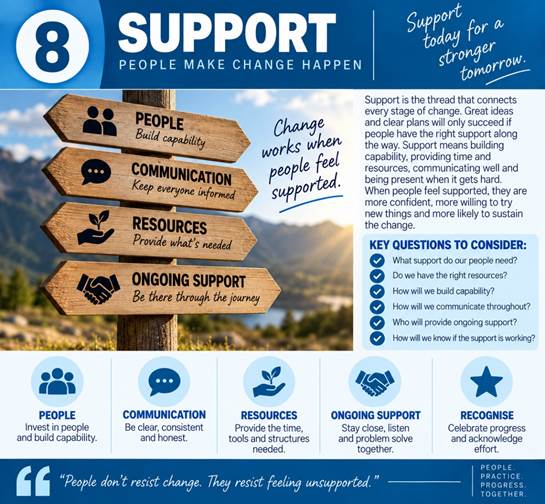
There is a reason support sits alongside the entire model rather than appearing as one stage. Support shouldn’t arrive only when someone is struggling or when implementation has gone wrong. People may need support to understand the case for change, interpret the standard or develop the capability to implement the practice. They may need coaching after a control measure identifies a gap, or they may need resources, time, modelling, feedback or simply an opportunity to ask questions.
Leadership has to provide that support, but support also doesn’t mean removing accountability. I think the two work together. We should be clear about the expectation, provide people with the capability and resources to meet it, check whether it is happening, support where required and then check again. That is a far more constructive approach than either extreme: announcing expectations and leaving people to work them out themselves, or providing endless support without ever determining whether practice has actually changed.
There is also something important about the timing of support. If we wait until the control measure identifies failure before providing capability development, we have probably left it too late. Support should be proactive as well as responsive. When we introduce a change, part of the implementation planning should be asking what knowledge, skills, resources and conditions people will need to be successful. Accountability is much more reasonable when we have first done everything we can to give people the opportunity to meet the expectation.
Change Is a Cycle
The more change I lead, the less convinced I am by big launches. Change doesn’t become embedded because we had a great presentation, produced a beautiful document or ran an inspiring professional development session. Those things can help, but they aren’t the change. Change becomes embedded because we create a disciplined process that takes an idea and progressively turns it into consistent practice.
We understand where we are and build the case for why we need to move. We define what good looks like and implement using research, best practice, experience and logic. We put control measures around the work, check the evidence, provide support and then recheck. What we learn informs the next scan, and the process begins again. Over time, the cycle becomes less about implementing individual initiatives and more about developing an organisation that knows how to improve.
Ultimately, the measure of successful change isn’t whether people heard the message, attended the training or whether the plan was rolled out. Those things tell us what we did, not what changed. The real measure is whether practice changed, whether that practice became consistent and, most importantly, whether the change made things better.
Michael Patane


Leave a Reply