Using the PEEP Protocol to move beyond experience and strengthen leadership decision-making.
One of the greatest challenges in school leadership is not making decisions, but ensuring that we have genuinely explored the possibilities before making them. As leaders, we are constantly presented with problems that require solutions. Whether it is improving student achievement, addressing behaviour, managing staffing or implementing school improvement priorities, we are expected to identify a way forward.
But I have noticed something interesting about how leaders approach these challenges. When asked to generate options, we almost always begin with our own experience. We think about what has worked previously, what we have seen in other schools, what we have implemented successfully or what someone else has told us worked for them.
There is nothing inherently wrong with this. Experience is valuable. It builds professional judgement, develops confidence and helps us recognise patterns. However, experience can also become a limitation. When our thinking is dominated by what we already know, we risk generating solutions that are familiar rather than solutions that are effective. We can find ourselves recycling the same approaches, sometimes with slightly different packaging, without genuinely challenging whether there might be a better way.
Our experience should inform our decisions, but it should not define the boundaries of our thinking. This is one of the reasons I have been developing the A-MAP leadership process, and particularly the Multiple Options stage.
A-MAP: A Structured Approach to Leadership Conversations
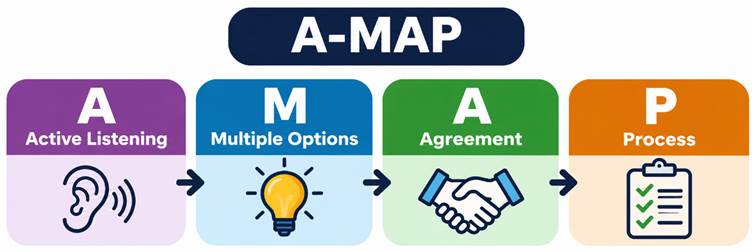
A-MAP is a leadership process designed to improve the quality of conversations, problem-solving and decision-making. It follows four stages:
- A – Active Listening: Understanding the problem, listening carefully and ensuring we have clarity about the issue.
- M – Multiple Options: Generating and exploring a range of possible solutions before deciding on a course of action.
- A – Agreement: Establishing a shared understanding and agreeing on the most appropriate way forward.
- P – Process: Determining the actions, responsibilities and processes required to implement the agreed solution.
The strength of A-MAP is that it prevents leaders from rushing straight from identifying a problem to implementing a solution. Too often, leadership conversations move directly from “Here is the problem” to “Here is what we should do.” The critical thinking that should happen between those two points is either rushed or overlooked.
The Multiple Options stage deliberately creates space to consider different approaches before deciding on a course of action. However, simply asking a leadership team to generate multiple options does not necessarily produce better thinking. Without structure, the conversation can quickly become a collection of personal experiences, individual preferences and familiar strategies. This is where PEEP comes in.
Introducing PEEP: Four Lenses for Generating Options
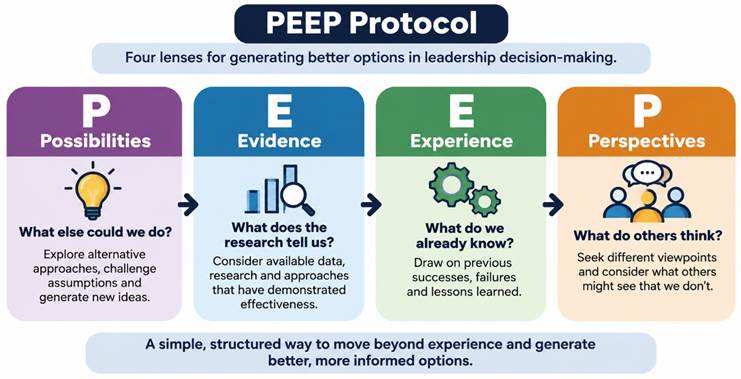
PEEP is a simple thinking protocol that sits within the Multiple Options stage of A-MAP. It encourages leaders to explore a problem through four different lenses rather than relying predominantly on their own experiences.
P – Possibilities: What else could we do?
Explore alternative approaches, challenge assumptions and generate new ideas.
E – Evidence: What does the research tell us?
Consider available data, research and approaches that have demonstrated effectiveness.
E – Experience: What do we already know?
Draw on previous successes, failures and lessons learned.
P – Perspectives: What do others think?
Seek different viewpoints and consider what others might see that we don’t.
The sequence is deliberate. We begin by opening up our thinking, examine evidence, draw on experience and then seek alternative perspectives. Each lens encourages a different type of thinking, helping leaders move beyond the immediate solutions that often dominate leadership conversations.
P – Possibilities: What Else Could We Do?
The first step is to deliberately broaden our thinking. Rather than immediately discussing what has worked previously, we begin by exploring what might be possible. What would we do if we were designing the approach from scratch? What assumptions are we making? Is there a completely different way of addressing the problem?
At this stage, the objective is not to judge every idea but to expand the range of potential solutions. Possibilities encourage creativity, curiosity and the willingness to challenge established practices. By starting here, we give ourselves permission to consider approaches that may sit outside our previous experiences.
E – Evidence: What Does the Research Tell Us?
Once we have opened up the possibilities, we need to consider the evidence. What does credible research suggest? What does our school data tell us? What approaches have demonstrated effectiveness in similar contexts? These questions help shift the conversation from personal preference towards informed professional judgement.
This is particularly important in education, where strategies can become popular without necessarily having strong evidence behind them. Evidence helps us distinguish between an interesting idea and an approach that has a reasonable likelihood of improving outcomes. It also challenges our personal beliefs, recognising that something which feels effective because we have used it previously may not be the most effective approach available.
E – Experience: What Do We Already Know?
Experience remains an important part of the process. We should absolutely draw on the professional knowledge of our teams, previous successes, failures and lessons learned. The important difference, however, is that experience is now one of four lenses rather than the starting point and dominant influence.
By deliberately placing Experience after Possibilities and Evidence, we reduce the likelihood of allowing familiar practices to narrow the conversation before other options have been considered. Experience becomes a source of insight rather than an automatic justification for repeating what we have always done. It allows us to reflect on previous approaches while remaining open to the possibility that a different solution may be more effective.
P – Perspectives: What Do Others Think?
The final lens encourages us to look beyond our own understanding of the problem. How might teachers view the issue? What would students say? What perspectives might parents, support staff or other school leaders contribute? Could someone outside education offer a useful way of thinking about the challenge?
One of the limitations of leadership teams is that people can develop similar ways of thinking, particularly when they have worked together for a long time. Seeking different perspectives helps expose assumptions, identify blind spots and generate options that may otherwise never have been considered. It also reinforces the importance of collective thinking, recognising that valuable insights are not limited to those holding formal leadership positions.
Why Relying on Experience Can Limit School Improvement
Consider a common challenge in schools: student reading outcomes are not improving at the rate we would like. In a traditional leadership discussion, someone might suggest increasing intervention groups because they have seen that approach work previously. Another leader might recommend purchasing a particular reading program because it was successful at their former school. Someone else might propose additional teacher aide support because that has been the school’s historical response.
All three suggestions come from experience, and all three might have merit. However, have we actually explored the problem? Have we examined the quality of Tier 1 classroom instruction? Have we considered what assessment data tells us about the specific reading difficulties students are experiencing? Have we investigated the research on effective reading instruction? Have we sought the perspectives of classroom teachers and students?
The danger is that we begin debating which familiar solution is best before we have considered the full range of possibilities. This is not simply a theoretical concern. Research into decision-making has identified how cognitive shortcuts, including availability bias, can influence the options people consider. Familiar or easily recalled approaches can dominate thinking, while alternatives receive less attention.
PEEP is designed to interrupt that pattern. Rather than allowing experience to dictate the conversation, it creates a deliberate opportunity to explore possibilities, examine evidence and consider different perspectives before drawing on what we already know.
What PEEP Looks Like in Practice
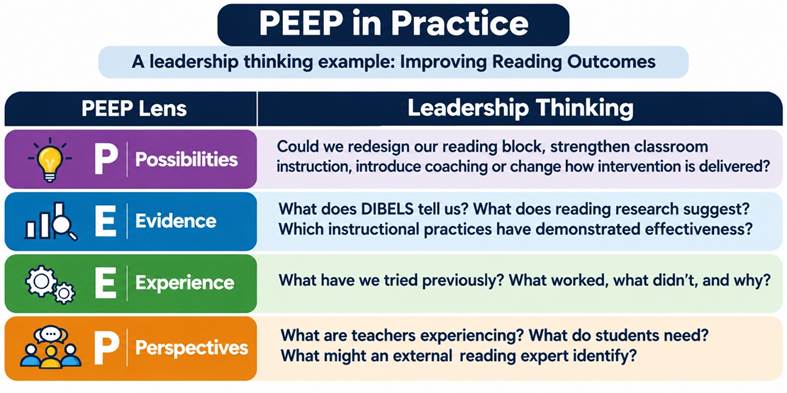
Using the reading example, a leadership team might work through the following conversation.
By the end of the process, the leadership team should have a broader and more informed set of options. Importantly, PEEP is not about generating as many ideas as possible. More options do not automatically mean better decisions. The purpose is to generate meaningfully different, well-informed options that address the actual problem.
It is also important to recognise that PEEP is not intended to turn every leadership discussion into a lengthy process. The four lenses can be explored through a relatively short, structured conversation. The value comes from the discipline of considering each lens rather than allowing the discussion to be dominated by whichever solution is suggested first.
Moving from PEEP to Agreement
Once the team has explored the four lenses, the conversation moves back into the broader A-MAP process. The Multiple Options stage has now provided a range of potential approaches, allowing leaders to move into the Agreement stage with greater confidence that they have considered more than just the most familiar solutions.
The Agreement stage is where leaders evaluate these options, consider their likely impact, feasibility and alignment with school priorities, and determine a preferred course of action. The final stage, Process, establishes how that decision will be implemented, who is responsible, what resources are required and how progress will be monitored.
This distinction matters because PEEP is not a decision-making tool in isolation. It is an option-generation tool that improves the quality of thinking before a decision is made. Its role is to strengthen the Multiple Options stage of A-MAP, ensuring that the eventual agreement is informed by a broader and more considered exploration of potential solutions.
Creating a Culture of Curiosity Rather Than Certainty
One of the most important shifts we can make as school leaders is moving away from the expectation that the most experienced person in the room should automatically have the best solution. Experience is valuable, but it is not infallible. Sometimes the person with less experience asks the question that challenges an assumption everyone else has accepted. Sometimes research contradicts a practice we have used for years, and sometimes a teacher, student or parent sees something that the leadership team has overlooked.
PEEP provides a structure that makes these possibilities part of the conversation. It also creates a more inclusive leadership environment, where the value of a contribution is determined by the thinking behind it rather than the position or experience of the person offering it. When leaders are prepared to explore possibilities rather than immediately defend their preferred solutions, they create opportunities for genuine professional learning and improvement.
This requires a degree of humility. As leaders, we need to be comfortable acknowledging that our previous experiences may not always provide the best answer to the challenges we currently face. We also need to recognise that asking better questions can be more valuable than immediately providing solutions.
Better Options Lead to Better Conversations
I believe that effective leadership is not about always having the answers. It is about creating the conditions where better answers can emerge. A-MAP provides the broader structure for purposeful leadership conversations, while PEEP strengthens one of the most important parts of that process: generating multiple options.
By deliberately considering Possibilities, Evidence, Experience and Perspectives, we can challenge our assumptions, broaden our thinking and avoid becoming trapped by familiar solutions. This does not mean abandoning our professional experience. It means recognising that experience is one valuable source of information within a much broader process of exploration and decision-making.
The next time a problem emerges in a leadership meeting, rather than immediately asking, “What have we done before?”, perhaps we should begin with a different question: “What else could we do?”
Because sometimes the greatest limitation on school improvement is not a lack of solutions, but the limited range of solutions we allow ourselves to consider.
Michael – The Primary Principal


Leave a Reply